
Last Updated on May 7, 2026 by Digiinte.com Team
Key Takeaways
- Holistic SEO treats your entire website as one connected system, not a checklist.
- Content quality, technical health, user experience, and authority all work together.
- Google algorithm updates reward holistic SEO rather than punishing it.
- Strong topical authority beats keyword stuffing every single time.
- A step-by-step audit and content plan is the best starting point for any website.
Most people treat SEO like a to-do list. Write some blog posts. Fix the page speed. Get a few backlinks. Tick the boxes and wait for Google to notice.
- What Is Holistic SEO?
- Holistic SEO vs Traditional SEO: What Makes Them Different?
- The Four Core Pillars of Holistic SEO
- Why Holistic SEO Protects You From Algorithm Updates
- How to Start Applying Holistic SEO to Your Website
- Common Mistakes to Avoid With Holistic SEO
- The Real Benefits of Taking a Holistic Approach
- Frequently Asked Questions
- Final Thoughts
The problem? That approach almost never works for long. You end up with a website that performs well in a couple of areas and quietly falls apart in others. And Google sees the whole picture, not just the parts you polished.
That is where holistic SEO comes in. It is a completely different way of thinking about your website and your rankings. Instead of fixing things in isolation, holistic SEO looks at your entire website as one connected system and improves every part of it together.
In this guide, you will learn exactly what holistic SEO is, how it is different from traditional SEO, what its core pillars are, and how you can start applying it to your website today to build rankings that actually last.
What Is Holistic SEO?
Holistic SEO is a comprehensive approach to search engine optimization that improves every important aspect of your website at the same time. That includes your content quality, your technical performance, your user experience, your website security, and your off-page authority.
The goal is simple: build a website that genuinely serves the people visiting it, in every way possible. When you do that consistently, search engines reward you for it.
Think of your website like a ship in a competition where Google is one of the judges. Your ship has an exterior design, an interior experience, and an engine that keeps everything moving. A beautiful exterior means nothing if the engine breaks down. A powerful engine is wasted if the interior is a mess. Every part has to work well together for the whole ship to perform.
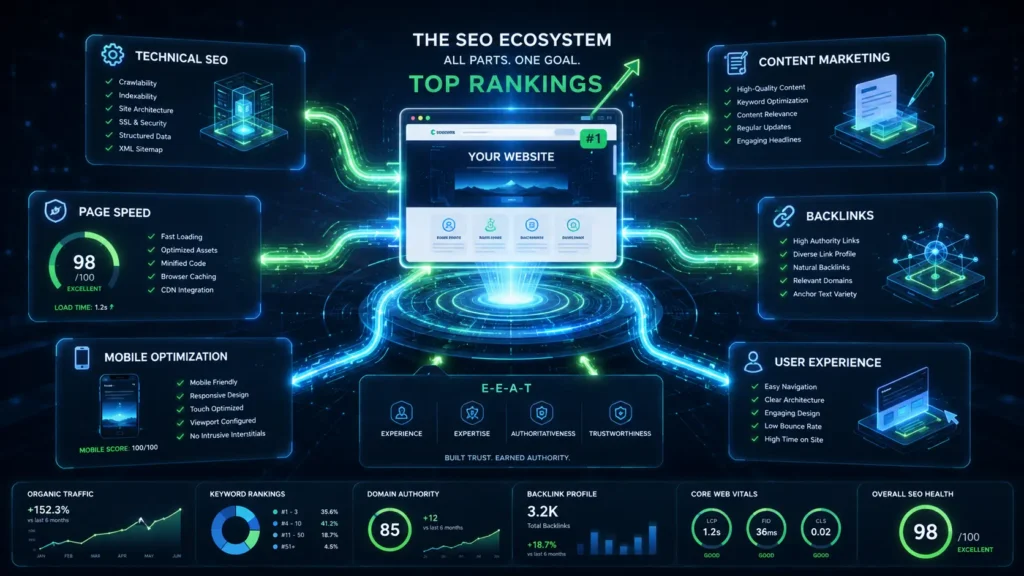
That is exactly how holistic SEO works. When any one part of your website is weak, it pulls down the performance of everything else. When every part is strong and connected, your rankings climb steadily and stay there.
Holistic SEO is not about tricking Google. It is about building a website that genuinely deserves to rank and then giving Google every reason to show it to the right people.
Holistic SEO vs Traditional SEO: What Makes Them Different?
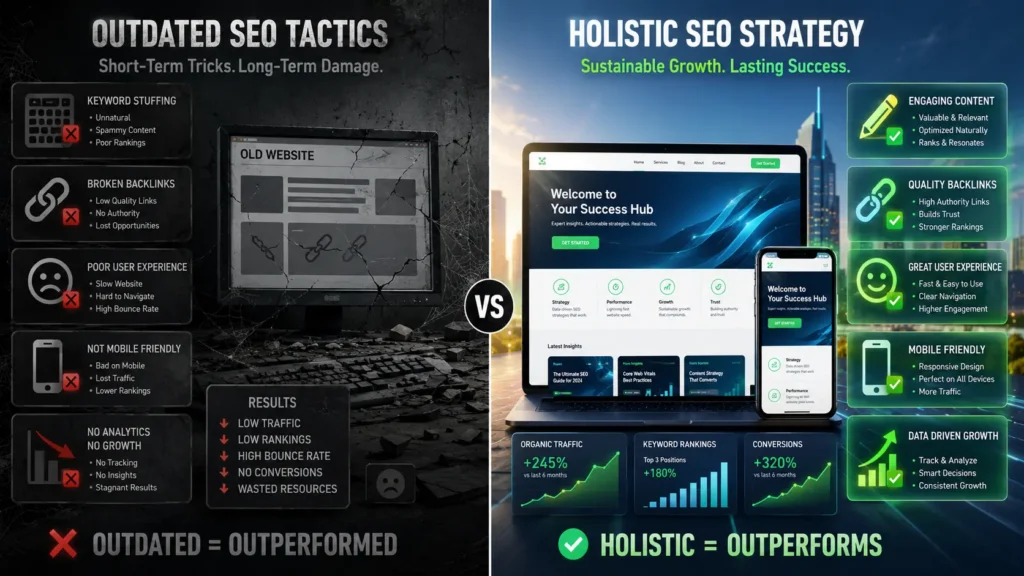
Traditional SEO focuses on individual tactics, often handled by different teams with different goals. One team works on keyword optimization. Another handles backlinks. A developer fixes technical issues. A content writer publishes blog posts. Everyone does their job, but nobody makes sure the efforts are reinforcing each other.
The result is a siloed strategy where improvements in one area do not support the others. Your fastest pages might not be the ones driving revenue. Your best backlinks might point to outdated content. Your blog posts might not link to the service pages that actually convert visitors.
Holistic SEO brings all of those pieces together into one unified strategy. Every improvement is designed to strengthen at least two other areas of your site. It is proactive rather than reactive, and it builds on itself over time.
Did You Know: Moving up just one position in Google search results can increase your click-through rate by 30.8 percent. That is why every single part of your website matters, not just the pages you are actively working on.
Traditional SEO chases algorithm changes. Holistic SEO builds something that algorithm changes reward. That distinction makes all the difference for long-term rankings.
The Four Core Pillars of Holistic SEO
A strong holistic SEO strategy is built on four pillars that work together. Developing all four consistently is what separates websites that rank long-term from websites that spike and fade.
Pillar One: Content Quality and Topical Authority
Content is the foundation of everything in SEO. But holistic SEO goes much further than writing individual blog posts around target keywords. It is about building topical authority across your entire subject area.
Topical authority means covering your core subject so thoroughly and so well that Google recognizes your website as a trusted source on that topic. This means creating pillar pages that explore broad topics in depth, supported by a cluster of related articles that tackle specific questions and subtopics. Each piece links naturally to the others, and together they show Google that your website truly understands the subject.
Great content also means content that matches real search intent. Every page should answer the specific question that brought the reader there, whether they are looking for information, comparing options, or ready to take action.
Pillar Two: Technical SEO and Site Performance
Even the most helpful content in the world will struggle to rank if your website is slow, broken, or difficult for Google to crawl. Technical SEO is the foundation that makes everything else possible.
Google’s Core Web Vitals are now a direct ranking factor. Your pages should load their main content in 2.5 seconds or faster. They should be visually stable and responsive to user input. On mobile devices, where most searches happen today, your site needs to perform just as well as on desktop.
HTTPS security, a clean site architecture, a properly submitted XML sitemap, and well-configured robots.txt files all fall under this pillar. When the technical foundation is solid, Google can find and understand your content more easily, and that makes every other part of your strategy more effective.
Pillar Three: User Experience
Google pays close attention to how real people interact with your website. If someone clicks on your page from the search results and immediately leaves, that signals to Google that your content did not deliver what they came for. If they stay and explore multiple pages, that is a strong signal that your site is genuinely useful.
Good user experience means easy navigation, clear calls to action, readable content with short paragraphs and helpful headings, and a mobile experience that feels natural and smooth. Studies show that almost 90 percent of users will not return to a website after a bad experience. Holistic SEO makes sure your first impression is always a strong one.
Pillar Four: Off-Page Authority and Trust
Even fast, well-written, easy-to-use websites can struggle to rank if Google does not view them as trustworthy. Authority is built through backlinks from credible sources, consistent brand mentions across the web, and content that genuinely demonstrates real-world expertise.
Google’s E-E-A-T framework, which stands for Experience, Expertise, Authoritativeness, and Trustworthiness, is central to how content quality is measured. Your content should reflect genuine knowledge and real experience. Your website should have a clear identity. The sources you reference should be reliable. And the links pointing to your site should come from places that actually matter in your industry.
Why Holistic SEO Protects You From Algorithm Updates
If you have done SEO for any length of time, you know how unsettling a major Google update can feel. Sites built on narrow tactics are always one update away from losing their rankings.
Holistic SEO is built differently. Because it is grounded in the principles Google has always valued, which are helpful content, trustworthy sources, and great user experiences, it tends to be rewarded by algorithm updates rather than punished by them.
Google’s Helpful Content Update and the March 2024 Core Update were specifically designed to surface websites that take a genuine, user-first approach while pushing down sites that rely on shortcuts. When your website serves users well across every dimension, you stop worrying about updates and start looking forward to them.
Sites built on providing real value to real people stay stable and keep growing through algorithm changes. Sites built on shortcuts are always one update away from collapse.

How to Start Applying Holistic SEO to Your Website
You do not have to overhaul your entire website overnight. Holistic SEO is a long-term strategy. The key is being intentional about where you start and building a plan that covers all four pillars progressively.
Step One: Run a Comprehensive Website Audit
Before you improve anything, you need to understand where you stand right now. Use tools like Google Search Console, Google Analytics 4, Semrush, and Ahrefs to get a complete picture of your site across content quality, technical health, user engagement, and backlink profile. Find your biggest gaps and prioritize from there.
Step Two: Build Content Around Topics, Not Just Keywords
Identify the core topics your website should be known for. Map out a content plan that covers each topic thoroughly, starting with a strong pillar page and building supporting cluster content around related questions. Use Google’s People Also Ask section, AnswerThePublic, and Semrush to find the real questions your audience is asking.
Step Three: Fix Your Technical Foundation
Run a Core Web Vitals test on your most important pages and address any failing scores. Check that your site is fully mobile-friendly. Review your internal linking structure to make sure it is logical and helps Google understand how your pages relate to each other. Confirm that your HTTPS certificate is active and your sitemap is submitted to Google Search Console.
Step Four: Improve the On-Page Experience
Go through your most visited pages and make sure they genuinely answer the reader’s question. Shorten long paragraphs. Add descriptive headings that make it easy to scan. Include clear next steps so visitors know what to do after reading. These changes can meaningfully reduce bounce rates and increase the time people spend on your site, both of which are positive signals for Google.
Step Five: Build Authority the Right Way
Focus on earning backlinks from websites that are genuinely relevant and respected in your space. Quality matters far more than quantity here. One strong link from a trusted source does more for your rankings than dozens of low-quality links. Guest posting, creating original research, and publishing genuinely useful resources are all reliable ways to earn the kind of authority that sticks.
Quick Tip: Link your cluster content pages back to your pillar pages using clear, descriptive anchor text. This helps Google understand your site structure and signals strong topical authority across your entire content plan.
Common Mistakes to Avoid With Holistic SEO
Understanding what to do is important, but understanding what not to do is just as valuable. Here are the most common mistakes that hold websites back even when they are trying to take a holistic approach.
Focusing only on keywords
Keywords are a guide to understanding what people are looking for, not the entire strategy. Overemphasizing keywords leads to content that feels unnatural and misses the actual point of the search.
Expecting fast results
Holistic SEO is a long-term investment. Building authority and earning trust takes time. If you are looking for overnight rankings, this is not the approach for you. But if you want rankings that last, it is the only approach that makes sense.
Neglecting content promotion
Publishing great content is only half the job. If nobody sees it, it cannot earn links or engagement. Share it through social media, email newsletters, and outreach so it gets in front of the right people.
Working in silos
The biggest mistake of all is letting your content team, technical team, and link-building team operate separately with no coordination between them. Every improvement should support the other areas of your strategy. When it does not, you are leaving a lot of potential on the table.
The Real Benefits of Taking a Holistic Approach
The results of holistic SEO take time, but they are far more durable than anything you can achieve with shortcuts. Here is what you can expect as your strategy matures.
Your organic traffic will grow more consistently because you will rank for a wide range of keywords across different intent types, not just a handful of high-competition terms you happen to have optimized for. Your conversion rates will improve because your website will be easier to use and your content will be more relevant to the people visiting it.
Your brand will build genuine authority in your space, which makes every future piece of content you publish perform better from the moment it goes live. And you will stop feeling anxious every time Google announces a major algorithm update, because your site is already doing what Google wants it to do.
Read More SEO Blogs
Want to go deeper on SEO? Check out these related guides:
➜ How to Use AI SEO to Improve Your Website
➜ What Is AIO SEO? How to Optimize for AI Search in 2026
Frequently Asked Questions
Final Thoughts
Holistic SEO is not a complicated concept. It is actually a very straightforward one: build a website that genuinely serves its visitors in every way possible, and search engines will reward you for it.
The challenge is not understanding it. The challenge is committing to it consistently, especially when the temptation to chase quick wins is always right there. But the websites that hold strong positions in search results year after year are the ones that made that commitment.
They have content that genuinely helps people. They have fast, clean, easy-to-navigate websites. They have earned real authority in their space through consistent quality. And they keep improving because they understand that every small improvement builds on the last one.
That is the real promise of holistic SEO. Not a shortcut to the top of Google, but a sustainable and reliable path to staying there.
