
Last Updated on May 9, 2026 by Digiinte.com Team
Key Takeaways
- AI search monitoring platforms track brand visibility across ChatGPT, Perplexity, Google AI Overviews, and other generative engines, not just Google rankings.
- Traditional SEO tools measure what happened; AI monitoring platforms show you why it happened and what is coming next.
- Generative Engine Optimization (GEO) is the discipline that has emerged around optimizing content for AI citations, and dedicated monitoring tools make it actionable.
- Real-time competitor intelligence from AI monitoring can reveal content gaps and prompt opportunities your rivals have not yet spotted.
- Businesses using AI-aligned content strategies have reported traffic and lead increases of up to 5x from LLM sources within a single year.
- Key Takeaways
- What Is an AI Search Monitoring Platform?
- Why Traditional SEO Tools Are No Longer Enough
- Key Benefits of Using an AI Search Monitoring Platform for SEO
- How to Use an AI Search Monitoring Platform to Improve Your SEO Strategy
- Understanding Generative Engine Optimization (GEO) and Why It Matters
- Common Mistakes to Avoid When Implementing AI Search Monitoring
- Expert Tips for Getting the Most Out of AI Search Monitoring
- Top AI Search Monitoring Tools Worth Considering
- Frequently Asked Questions
- Conclusion
Search has changed. Not a little. Fundamentally. Google processes 8.5 billion searches every day, and a growing slice of those now end in an AI-generated answer rather than a list of blue links. ChatGPT, Perplexity, Google AI Overviews, and Gemini are pulling answers directly from pages they consider authoritative. Your page can rank on page one and still lose traffic because an AI system chose a competitor to cite in its summary instead. That is the new battlefield for organic visibility, and traditional SEO tools were not built to track it.
An AI search monitoring platform closes that gap. It watches how AI engines interpret, cite, and describe your content in real time. It surfaces the competitor strategies you cannot see in a standard rank tracker. And it gives SEO teams the intelligence they need to stop reacting to traffic drops and start preventing them. This guide explains exactly how these platforms work and why they have become essential to any serious SEO strategy in 2025 and beyond.
What Is an AI Search Monitoring Platform?
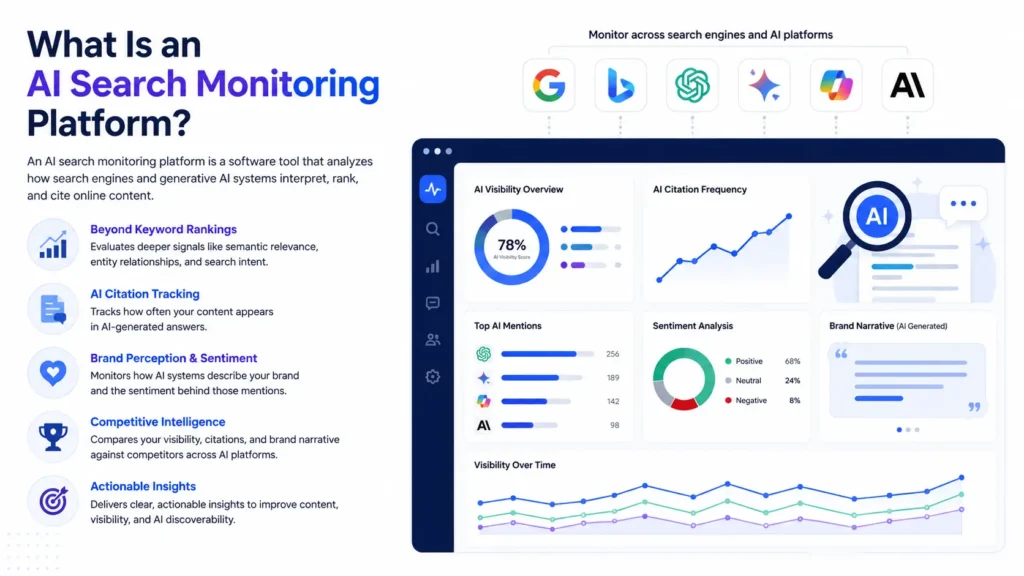
An AI search monitoring platform is a software tool that analyzes how search engines and generative AI systems interpret, rank, and cite online content. Rather than focusing only on keyword positions, it evaluates deeper signals: semantic relevance, entity relationships, search intent, AI citation frequency, and brand sentiment across AI-generated responses. It tracks how often your content appears in AI answers and how AI systems describe your brand relative to competitors.
Why Traditional SEO Tools Are No Longer Enough
Traditional SEO relies heavily on Google Search Console, keyword rank trackers, and periodic site audits. These tools are useful. They are also increasingly incomplete. Here is the core problem: your traffic can decline even when your rankings hold steady.
AI systems extract information from authoritative sources and display it directly in summaries or conversational responses. A competitor’s article might appear prominently in a Google AI Overview while your page sits below it in the organic results. You would never see that conflict in a standard rank tracker. You would only notice it when your organic click-through rate starts falling for no obvious reason.
Research published in August 2025 analyzing 10,000 keywords found only 9.2% URL consistency in Google AI Mode across repeat queries. That level of volatility means brands that are not monitoring their AI presence are flying blind through constant change. Traditional tools capture yesterday’s ranking; AI monitoring platforms capture today’s citation reality.
Key Benefits of Using an AI Search Monitoring Platform for SEO
1. Real-Time Visibility Into AI Citations
These platforms show you exactly when and how your content is referenced inside AI-generated answers. You can see which pages get cited, which prompts trigger your brand, and how often you appear compared to competitors. Surfer’s AI Tracker, for example, shows visibility scores and competitor citation data across ChatGPT, Perplexity, and Google AI Overviews from a single dashboard.
2. Competitor Intelligence You Cannot Get Anywhere Else
An AI monitoring platform can reveal which prompts your competitors appear for that you do not. Surfer’s Mention Gap report, for instance, shows exactly where a rival gets cited in AI responses while your brand is absent. That is a direct content opportunity. You can create or improve material that fills those gaps, earning citations your competitors currently own.
3. Smarter Keyword and Prompt Strategy
Traditional keyword research tells you what people type into Google. AI monitoring adds a new layer: what prompts users enter into ChatGPT, Perplexity, and Gemini to find solutions in your category. Platforms like Peec AI and OtterlyAI automatically convert keywords into AI prompts and measure how visible you are for each one. That kind of data reshapes how you plan content. You stop chasing search volume alone and start targeting the questions AI engines are actually answering.
4. Predictive Analytics and Early Warning Systems
Waiting for traffic to drop before investigating is a reactive, expensive approach. AI monitoring platforms detect patterns in ranking volatility and prompt frequency shifts before those changes become traffic losses. SE Ranking, for example, uses machine learning to flag irregularities in keyword rankings and SERP volatility, alerting teams to potential algorithm shifts long before they become industry talking points. That early warning gives you time to adjust content strategy, update pages, and protect visibility proactively.
5. Brand Sentiment Monitoring Across AI Engines
How AI systems describe your brand matters. If ChatGPT consistently frames you as a budget option when you want to be seen as premium, that framing influences buying decisions. AI monitoring platforms like Semrush AI Toolkit and Peec AI surface brand sentiment across generative engines, so you can see exactly how AI tools talk about your business and take corrective action when the framing is off.
6. Content Gap Discovery at Scale
Platforms like Siteimprove automatically scan entire sites and flag pages that are missing key topic coverage. Combined with AI citation data, this reveals not just what you are not writing about but what you need to write about to earn AI mentions in your category. The content gap is no longer a guess. It is a specific list of topics, backed by data, that competitors are winning on.
How to Use an AI Search Monitoring Platform to Improve Your SEO Strategy
- Set up prompt tracking. Begin with 20 to 30 prompts your target audience would enter into AI engines. These should map to your core product or service categories. Tools like OtterlyAI and Peec AI let you configure these inside the platform and start measuring your AI visibility within hours.
- Audit your current AI citations. Run your brand name and key topic areas through the platform to see where you currently appear in AI responses. Identify which pages are being cited and which are being ignored. Often you will find that a few well-structured pages drive most of your AI mentions, while the rest of your site is invisible to generative engines.
- Analyze the competitor gap. Use the mention gap or competitor intelligence features to find prompts where rivals appear but your brand does not. Prioritize those gaps by search volume and business relevance. These are your highest-leverage content opportunities.
- Audit your content for semantic depth. AI engines reward topical authority over keyword density. For each content gap you identify, check whether your existing pages cover the topic thoroughly enough, including related entities, subtopics, and common user questions. If they do not, restructure or expand them.
- Monitor AI brand sentiment. Set up regular sentiment checks across ChatGPT, Perplexity, and Google AI Mode. If AI systems describe your brand inaccurately or unfavorably, track which pages or sources appear to be influencing that framing and work to improve them.
- Connect AI insights to your content calendar. Feed the prompt data and competitor gaps directly into your editorial planning. Every new piece of content should have a clear connection to a prompt your brand is not yet winning, or a citation your competitor currently holds.
- Track progress weekly. AI search visibility changes faster than traditional rankings. A weekly cadence for reviewing citation rates, visibility scores, and brand sentiment keeps your strategy responsive rather than reactive.

Understanding Generative Engine Optimization (GEO) and Why It Matters
Generative Engine Optimization, or GEO, is the practice of optimizing content specifically to appear in AI-generated answers. It is distinct from traditional SEO. Where SEO focuses on ranking a page in organic results, GEO focuses on making content structured, factual, and authoritative enough that AI systems choose to cite it.
The GEO discipline emerged directly from the rise of tools like AI search monitoring platforms. Once marketers could measure how often their content appeared in AI citations, the next question became obvious: how do you improve that number? The answer involves writing content that is factually precise, well-structured with clear headings, grounded in specific data, and free of vague generalities.
Peec AI users who prioritized their AI citation strategy reported a 5x year-over-year increase in traffic and demo requests from LLM sources. That is not a marginal gain. It reflects a fundamental shift in where search traffic originates and how brands need to compete for it.
Common Mistakes to Avoid When Implementing AI Search Monitoring
Treating AI monitoring as a replacement for traditional SEO
These tools are complementary, not competing. You still need to rank well in organic results. AI monitoring adds a layer of intelligence on top of your existing SEO foundation. Brands that abandon keyword and technical SEO in favor of GEO alone miss half the picture.
Monitoring too few prompts
Setting up five prompts and calling it done gives you a dangerously narrow view. Your audience uses hundreds of variations to describe problems your product solves. Start broader and refine as data accumulates.
Ignoring brand sentiment data
Many teams focus solely on citation frequency and ignore how AI describes their brand. If an AI engine consistently frames your product as suited for beginners when your target customer is an enterprise buyer, that misalignment has real commercial consequences.
Failing to act on competitor gap data
Knowing where competitors get cited without acting on it is a missed opportunity. The gap data is only valuable if it feeds your content calendar and editorial decisions on a regular basis.
Reviewing data too infrequently
AI search results change with high volatility. Research from 2025 showed that not a single keyword studied had the same URLs appearing in AI Overviews 100% of the time across a 31-day period. Weekly reviews at minimum are necessary to stay current.
Expert Tips for Getting the Most Out of AI Search Monitoring
- Prioritize structured content. AI engines cite pages with clear headings, concise definitions, and numbered steps far more frequently than dense, paragraph-heavy articles. Reformatting existing content to match this structure often produces measurable citation gains without writing a word of new material.
- Use data-driven statements. Phrases like ‘according to industry data’ or ‘research from Semrush shows’ signal factual authority to both AI engines and human readers. Specific statistics outperform vague claims in AI citation rates.
- Build entity coverage deliberately. AI systems use knowledge graphs to evaluate topical authority. If you are writing about SEO, your content should also reference related entities: algorithm updates, specific platforms, measurement frameworks, and named methodologies. Broad entity coverage signals depth.
- Combine AI monitoring with Google Search Console data. Cross-referencing your AI citation trends with impressions and CTR data from Search Console reveals where AI answers are cannibalizing your organic clicks. That correlation shows you exactly where to invest in GEO improvements.
- Monitor competitors who are not your direct rivals. Sometimes a media publisher or an industry blog earns more AI citations in your category than your actual competitors. Monitoring those sources reveals the content format and depth required to displace them.
Top AI Search Monitoring Tools Worth Considering
| Tool Name | Primary Purpose | Pricing Tier |
| Semrush AI Toolkit | AI Overview tracking, brand visibility, competitive analysis | From $139.95/month + $99/month AI add-on |
| OtterlyAI | Prompt monitoring, AI citation tracking, GEO analytics | Free trial available; paid plans vary |
| SE Ranking | Keyword rank tracking, AI Overviews, site audit | Plans from approx. $65/month |
| Surfer AI Tracker | AI visibility score, competitor prompt tracking | Part of Surfer plans starting from $89/month |
| Peec AI | LLM visibility monitoring, brand sentiment in AI answers | Custom pricing for teams |
Frequently Asked Questions
Conclusion
The way people find information has fundamentally shifted. AI-generated answers now sit between a search query and the web pages that answer it, and the brands that appear inside those answers earn the clicks, the trust, and the business. An AI search monitoring platform is the infrastructure that makes optimizing for this new reality possible.
Read More SEO Blogs
Want to go deeper on SEO? Check out these related guides:
➜ How to Use AI SEO to Improve Your Website
➜ What Is AIO SEO? How to Optimize for AI Search in 2026
From real-time citation tracking to competitor prompt intelligence to predictive analytics, these platforms give SEO teams the visibility they need to compete where the audience actually is, not just where Google traditionally ranked pages. The businesses that act on this shift now, while competitors are still relying on traditional rank trackers alone, will build a meaningful and durable advantage.
Start by auditing your current AI visibility. Set up a core set of prompts. Identify your first competitor gap. The data will show you exactly where to focus.
