
Last Updated on May 11, 2026 by Digiinte.com Team
Key Takeaways
- AI Overviews now appear on over 90% of informational queries in 2026, making E-E-A-T and structured content more critical than ever.
- Featured snippets still reward direct 40–60 word answers under question-style H2/H3 headings.
- Schema markup is the highest-ROI technical step for unlocking rich snippets, knowledge panels, and AI Overview citations.
- People Also Ask boxes have expanded to multi-topic clusters — target related question sets, not isolated queries.
- Zero-click SEO is a brand-building tool. Feature visibility drives higher-intent clicks and trust at scale.
- Local SEO in 2026 centers on Google Business Profile completeness, genuine reviews, and AI-powered local Q&A.
- What Are SERP Features?
- Why SERP Features Matter for Your SEO Strategy in 2026
- The Main Types of SERP Features and How to Target Each One
- Step-by-Step Guide to Optimizing for SERP Features
- SERP Feature Optimization Quick Reference — 2026
- Common Mistakes to Avoid
- Expert Tips for Winning SERP Features in 2026
- Frequently Asked Questions
- Conclusion
Search results do not look the way they used to. Open Google right now and search for almost anything. What you see is not a list of blue links — it is an AI-generated overview at the top, a featured snippet box, expandable People Also Ask questions, a map pack for local queries, image rows, and video carousels. These elements are called SERP features, and in 2026 they dominate the page from top to bottom.
According to Semrush data from early 2026, fewer than 1% of Google search results appear without any SERP feature at all. Meanwhile, Google AI Overviews have expanded to cover over 90% of informational queries — up from 83% in August 2025. If you are only optimizing for traditional organic rankings, you are invisible where most users actually look. This guide shows you how to optimize for every major SERP feature so your brand earns the visibility, trust, and traffic that comes with owning search real estate in 2026.
What Are SERP Features?
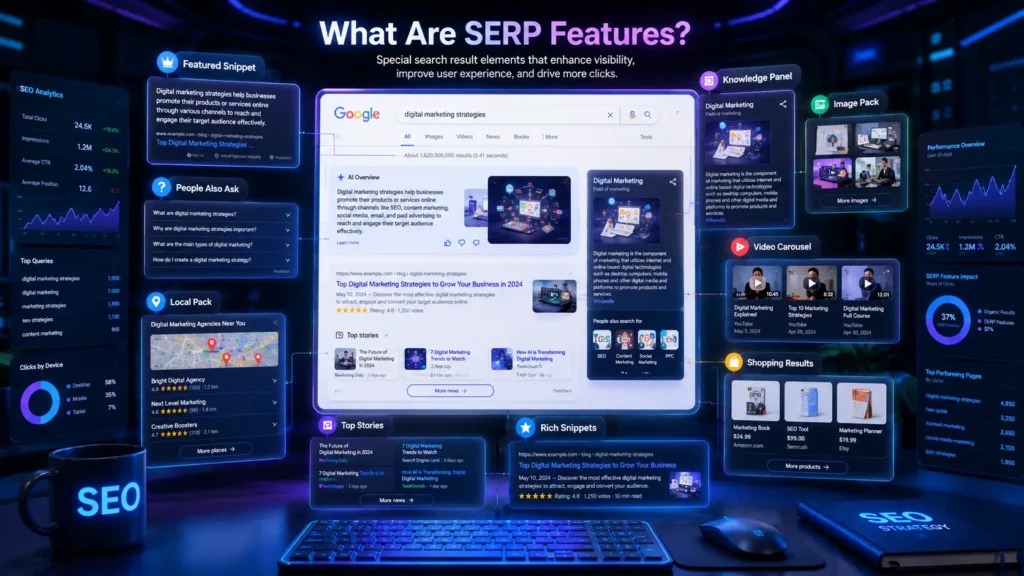
SERP features are any element on a Google search results page that goes beyond the traditional list of organic blue links. They include featured snippets, People Also Ask boxes, AI Overviews, knowledge panels, local packs, image carousels, video results, rich snippets, and sitelinks. Google introduced featured snippets in 2014 and has continuously expanded these features — most dramatically through the rollout of AI Overviews in 2024 and 2025. They exist to help users find answers faster, often directly on the search page itself.
Why SERP Features Matter for Your SEO Strategy in 2026
Here is the reality of search in 2026: over 65% of searches still result in no organic click at all. Users read the answer surfaced by a SERP feature and move on. That sounds like bad news — but the brands that appear in those features are the ones building awareness, authority, and brand recall with every impression.
SERP features matter for three specific reasons. First, they capture visual attention before a user ever reaches position one. Second, appearing in a feature signals to users that Google has validated your content as credible. Third, users who click through from a featured snippet or PAA box are higher-intent — they already read a summary of your answer and chose to learn more.
A Sistrix study found that position-one click-through rates drop by an average of 5.3% when a featured snippet also appears. That same snippet, however, drives its own clicks. The net result: feature holders benefit while organic-only pages below them lose ground.
In 2026, the addition of AI Overviews has amplified this dynamic further. Pages cited in AI Overviews receive strong authority signals even when users do not click. You want to be cited. You want to be the feature holder.
The Main Types of SERP Features and How to Target Each One
Featured Snippets
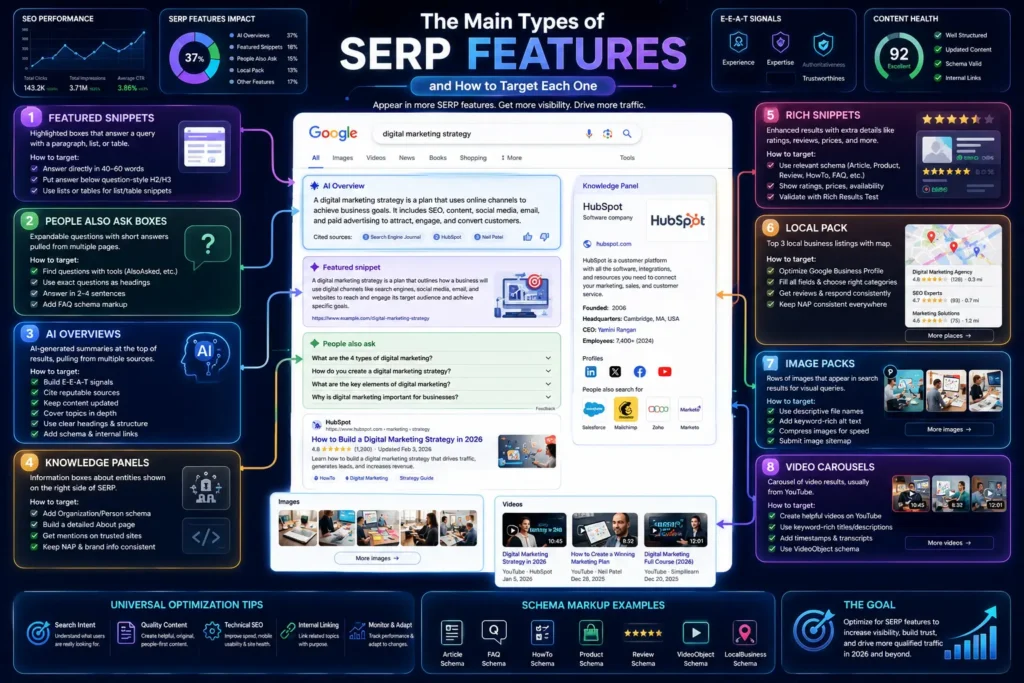
A featured snippet is a highlighted box that appears at or near the top of search results, pulling a specific paragraph, list, or table from a web page to directly answer a query. Paragraph snippets still account for roughly 70% of all featured snippets, appearing most often for definitional, how-to, and comparison queries.
To optimize for a featured snippet, write a direct answer of 40 to 60 words immediately below a question-style H2 or H3 heading. Put the clearest, most concise version of the answer first — then expand with supporting detail below it. If the snippet currently held by a competitor is vague, outdated, or poorly structured, that is your opening.
For list-style snippets, use properly formatted numbered or bulleted HTML lists. For table snippets, use structured HTML tables with descriptive column headers. These formats signal to Google’s systems how to extract and display your content.
People Also Ask Boxes
People Also Ask (PAA) is an expandable accordion box that shows related questions alongside short answers pulled from various web pages. In 2026, PAA has evolved into multi-topic question clusters — expanding each question now triggers further related questions across adjacent topics, creating near-infinite content and ranking opportunities for brands that cover subjects with depth.
To appear in PAA boxes, identify the exact questions your audience is searching. Tools like AnswerThePublic, AlsoAsked, Ahrefs, and Google Autocomplete are useful here. Then structure your content with those exact questions as headings and follow each heading with a short, clear answer of two to four sentences. Adding FAQ schema to these sections signals to Google that your page is specifically designed to answer questions.
AI Overviews
Google AI Overviews are AI-generated summaries that appear at the very top of search results. By early 2026, they cover over 90% of informational queries and pull from multiple sources rather than a single page. Being cited in an AI Overview requires your content to be considered authoritative across a topic — not just well-optimized for a single keyword.
Optimizing for AI Overviews means building genuine E-E-A-T signals: Experience, Expertise, Authoritativeness, and Trustworthiness. Include author credentials, cite reputable external sources, keep content updated at least quarterly, and cover topics with real depth rather than surface-level summaries. Structured, factual content with clear headings outperforms long, unstructured prose in AI Overview citations. Schema markup and internal topic clustering further improve your eligibility.
Knowledge Panels
Knowledge panels appear on the right side of the SERP and display information about entities — brands, people, places, and organizations. They pull data from Google’s Knowledge Graph, which sources from Wikidata, Wikipedia, and structured data on your own site.
To improve your chances of earning a knowledge panel, implement Organization or Person schema markup on your site. Maintain a detailed, link-rich About page that references reputable external sources. Secure mentions on trusted third-party databases like Wikidata, Crunchbase, and LinkedIn. Consistency matters: your business name, logo, and description must be uniform across your website, social profiles, and all external mentions.
Rich Snippets
Rich snippets enhance standard organic listings with extra visual information such as star ratings, prices, review counts, product availability, or recipe metadata. They do not relocate your result on the page, but they make your listing dramatically more eye-catching than a plain blue link — and in 2026, eye-catching matters more than ever as AI Overviews push standard results further down.
Rich snippets are powered by schema markup — structured data added to your HTML that tells Google precisely what your content represents. Use Article schema for blog posts, Product and Review schema for ecommerce pages, HowTo schema for instructional content, and FAQ schema for Q&A sections. Validate all schema using Google’s Rich Results Test before publishing.
Local Pack
The local pack — sometimes called the Google 3-Pack or map pack — shows three local business listings alongside a Google Maps embed. It appears whenever Google detects local intent behind a query. In 2026, Google has integrated AI-powered Q&A into the local pack, making your Google Business Profile responses and review content more important than ever.
To appear in the local pack, fully optimize your Google Business Profile. Fill in every field: business category, hours, phone number, website, photos, and services. Earn genuine customer reviews and respond to every one consistently. Ensure your NAP (Name, Address, Phone Number) is identical across your website, Google Business Profile, and every local directory where your business appears. Small inconsistencies — abbreviating Street to St in one place — can confuse Google’s local ranking signals.
Image Packs and Video Carousels
Image packs appear as a horizontal row of images in search results, typically for visual queries related to products, travel, fashion, or how-to topics. Video carousels feature YouTube thumbnails and appear for instructional, entertainment, or research-focused queries.
For image optimization: rename files with descriptive, keyword-relevant names before uploading. Add accurate alt text that describes the image while naturally incorporating your target keyword. Compress images for fast loading and submit an image sitemap to Google Search Console. For video: host on YouTube with keyword-rich titles and descriptions, add timestamps and a full transcript, and mark up video pages with VideoObject schema so Google can surface your content in video carousels.
Step-by-Step Guide to Optimizing for SERP Features
- Identify which SERP features your target keywords already trigger. Search each keyword manually or use Semrush and Ahrefs to see which features appear. This tells you what format Google prefers for that query and where your opportunity lies.
- Audit who currently holds the feature. Read their answer critically. Is it vague? Too long? Outdated? Those weaknesses are your entry point.
- Match your content format to the feature type. List snippet → use a properly formatted bulleted or numbered list. Paragraph snippet → write a direct 40–60 word answer. Table snippet → build a well-structured comparison table.
- Write your direct answer first. For every question-style heading, put your best answer in the first paragraph below that heading. Do not bury the lead.
- Add schema markup for every content type you publish. FAQ schema for Q&A sections, HowTo schema for step-based content, Product schema for ecommerce, Article schema for editorial content.
- Validate your schema using Google’s Rich Results Test before publishing. Invalid schema does nothing — and can occasionally cause indexing issues.
- Optimize your Google Business Profile if local SEO is relevant. Treat it like a second homepage. Incomplete profiles rarely appear in the local pack.
- Monitor SERP feature performance monthly using Google Search Console. Check the Search Appearance report for rich result impressions and clicks. Track specific keywords in Semrush or Ahrefs to see when you earn or lose features.
SERP Feature Optimization Quick Reference — 2026
| SERP Feature | Optimization Tactic | Key Tool |
| Featured Snippet | Write a direct 40–60 word answer below the H2/H3 heading | Google Search Console, Semrush |
| People Also Ask | Question-style headings + FAQ schema; target question clusters | Ahrefs, AnswerThePublic, AlsoAsked |
| AI Overviews | Build E-E-A-T signals; structured, factual, cited content | Semrush AI Toolkit, Surfer AI |
| Local Pack | Optimize Google Business Profile; consistent NAP; earn reviews | Google Business Profile, Moz Local |
| Knowledge Panel | Organization schema + Wikidata mentions + strong About page | Google Search Console, Schema.org |
| Rich Snippets | Implement FAQ, HowTo, Review, or Product schema | Yoast SEO, Rank Math, Schema App |
| Image Pack | Descriptive filenames, keyword-rich alt text, image sitemap | Google Search Console, TinyPNG |
| Video Carousel | Host on YouTube; timestamps; VideoObject schema | YouTube Studio, Semrush |
Common Mistakes to Avoid
Writing answers that are too long or too vague
Google wants a clean extract — not a summary of your entire article. If your answer paragraph runs past 70 words, it becomes harder for Google to pull a usable snippet. Keep featured-snippet target paragraphs tight and direct.
Ignoring schema validation
Adding schema markup and skipping the validation step is one of the most common mistakes in technical SEO. Invalid schema does not improve your eligibility for rich results. Always use Google’s Rich Results Test or the Schema Markup Validator to confirm your implementation is error-free before you publish.
Targeting features without ranking first
Featured snippets and PAA results almost always come from pages that already rank in the top ten organic positions. If a page ranks on page two, no amount of snippet-style formatting will win a feature. Build the underlying ranking first, then optimize for the feature on top of it.
Treating all SERP features equally
A local business does not need to prioritize video carousels. An ecommerce store does not need to obsess over knowledge panels. Match your feature optimization efforts to your business model and the genuine intent behind your target queries.
Keyword cannibalization across similar pages
When multiple pages on your site answer the same question in similar ways, Google may not know which one to feature. Consolidate thin, overlapping content into one strong, comprehensive page rather than splitting the topic across several weaker ones.
Expert Tips for Winning SERP Features in 2026
- Use Google Autocomplete and the People Also Ask box itself as free keyword research. Expand seven to ten questions in the PAA box for any target topic and collect those queries into your content outline. Each one is a potential feature opportunity.
- Refresh snippet-optimized pages at least quarterly. Featured snippet rankings change as content ages. Outdated statistics or deprecated processes can cost you a feature even if your structure is perfect.
- Test different answer formats. If your paragraph-style answer is not winning the snippet after two months, try rewriting it as a numbered list or adding a comparison table. Google shifts its preferred format based on how users interact with current results.
- Place your clearest call-to-action immediately after your featured snippet answer. Users who click through from a SERP feature are already engaged — they read your answer and chose to learn more. A well-placed CTA captures that high-intent traffic before it bounces.
- Build topical authority before chasing individual features. Brands that own multiple pieces of content across a topic cluster earn more AI Overview citations and PAA placements than brands with a single strong page. Depth across a topic signals sustained expertise to Google’s systems.
- In 2026, optimize specifically for AI Overview citations by ensuring every factual claim in your content cites a reputable external source. AI Overviews preferentially pull from content that demonstrates documented evidence rather than unsupported assertions.
Frequently Asked Questions
Conclusion
The Google search results page in 2026 is a curated experience built around features that answer questions before users ever reach a traditional organic result. For SEO teams that understand how to optimize for SERP features, this is a genuine competitive advantage. For those who do not, it is an invisible drain on traffic and brand visibility.
Read More SEO Blogs
Want to go deeper on SEO? Check out these related guides:
➜ How to Use AI SEO to Improve Your Website
➜ What Is AIO SEO? How to Optimize for AI Search in 2026
Start with the features most relevant to your business. If you publish informational content, focus on featured snippets and PAA boxes first. If you run a local business, your Google Business Profile is the highest priority. If you sell products, implement Product and Review schema. Each feature type has a clear, learnable optimization path.
