

Last Updated on May 6, 2026 by Digiinte.com Team
Key Takeaways
✔ Google prioritizes useful, user-focused content above everything else.
✔ Human input is what truly strengthens E-E-A-T, quality, and reader trust.
✔ Low-quality AI writing can quietly reduce your visibility and user engagement.
✔ Well-edited ChatGPT content is a genuine SEO asset when used the right way.
✔ The best results come from combining AI efficiency with real human expertise.
Every marketer, blogger, and business owner has asked this question at least once. You open ChatGPT, type in your topic, and get a perfectly worded article in seconds. It feels too easy. And then the worry sets in: is Google going to punish me for this?
The short answer is no. But the complete answer is a little more interesting than that.
Google does not care whether a human or a machine wrote your content. What Google truly cares about is whether your content is helpful, original, and trustworthy. The moment your AI-generated blog starts feeling thin, robotic, or just a copy of what every other site already says, that is when your rankings start to slip.
In this blog, we are going to walk through exactly what the risks are, what the benefits are, and how to use ChatGPT in a way that actually helps your SEO instead of quietly hurting it.
What Does Google Actually Think About AI Content?
This is where a lot of people get confused. Google has been very clear on its official position: using AI to generate content is not against their guidelines. What is against their guidelines is producing content that exists only to manipulate search rankings, not to help real readers.
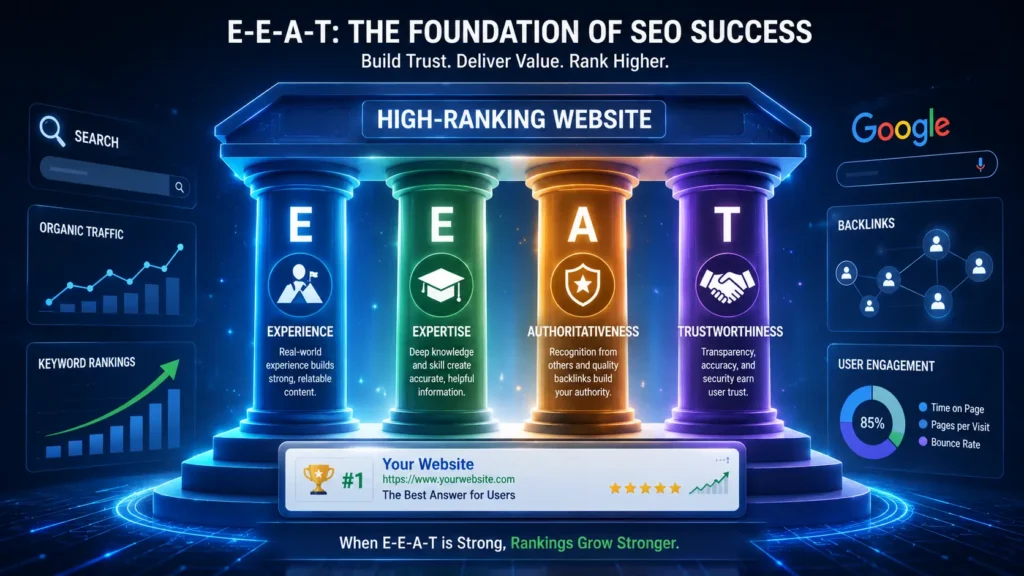
Google’s ranking system is built around something called E-E-A-T. That stands for Experience, Expertise, Authoritativeness, and Trustworthiness. These four qualities are what Google’s quality evaluators look for in any piece of content, regardless of how it was made.
So if your AI-generated article genuinely answers a reader’s question, provides accurate information, and comes from a website with a good reputation, Google is perfectly happy to rank it. The source of the writing does not matter. The quality of the writing does.
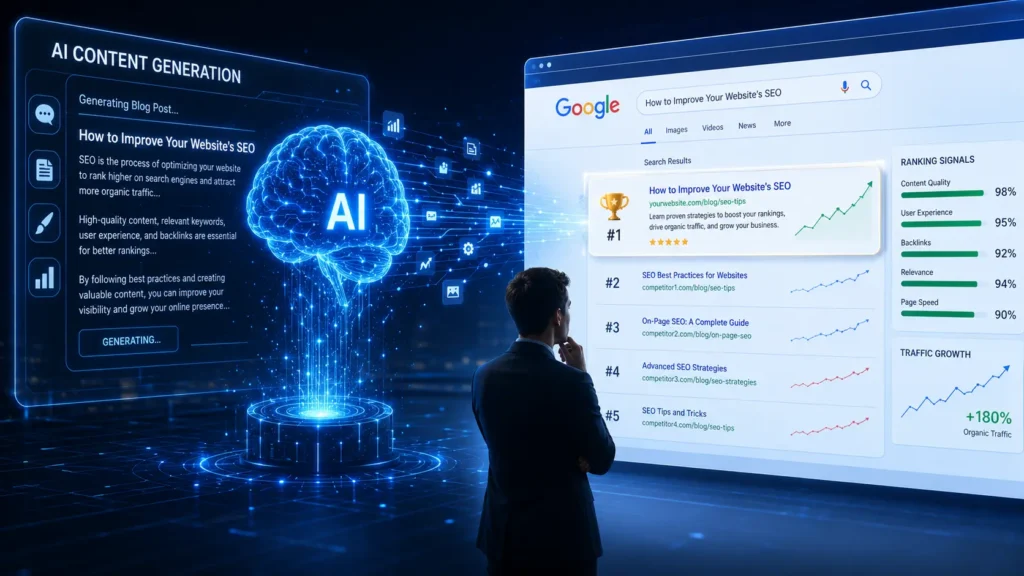
Tip: A study of 600,000 webpages found that about 86% of top-ranking pages included some form of AI-assisted text. That tells you something important about what is actually working online today.
So When Does ChatGPT Content Actually Hurt Your SEO?
Even though Google does not penalize AI content by default, there are real and specific ways that poorly used AI writing can damage your rankings. Let us look at each one honestly.
The Thin Content Problem
ChatGPT is excellent at filling pages with words. But words without depth are what SEO professionals call thin content. If your blog post technically answers a question but does not provide real insight, original analysis, or genuinely useful information, it is thin content. Google’s algorithm is very good at detecting this kind of padding, and it will push that content down in the rankings over time.
The fix is straightforward. Use ChatGPT to build the skeleton of your article, then go back and add the meat. Add your own examples. Share something from your experience. Include a data point or two that ChatGPT would not know. That is what separates a page that ranks from a page that gets buried.
The Duplicate Content Risk
Here is something most people do not consider. When hundreds of websites ask ChatGPT the same question with similar prompts, ChatGPT gives them similar answers. This fills the internet with content that is not exactly copied but feels nearly identical in structure, phrasing, and information.
Google does not like seeing the same information repeated across multiple pages with nothing unique to add. It will choose one page to rank and push the others aside. If your content does not stand out from the crowd, it will get lost in it.
The Engagement Signal Problem
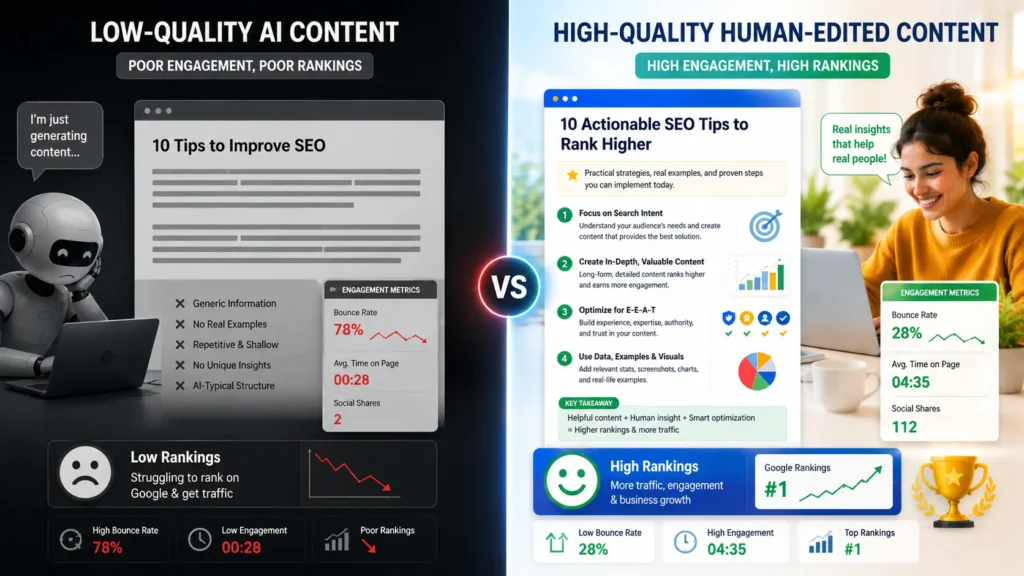
Google watches how real people interact with your content. If someone lands on your page and leaves after ten seconds, that is a signal that your content did not deliver what they were looking for. If your AI content sounds flat, reads robotically, or fails to hold a reader’s attention, your bounce rate goes up and your rankings go down.
This is one of the most underrated SEO risks of relying too heavily on raw AI output. The content might be grammatically perfect but emotionally empty. Readers feel that difference even if they cannot name it.
The Accuracy Problem
ChatGPT can be confidently wrong. It sometimes presents outdated statistics, misattributes quotes, or fills in gaps in its knowledge with plausible-sounding but incorrect information. If you publish that information without fact-checking it, you are not just risking your SEO. You are risking your credibility.
Google’s E-E-A-T guidelines specifically emphasize trustworthiness. A page full of inaccuracies will struggle to build the kind of authority that sustains long-term rankings.
The Real Benefits of Using ChatGPT for SEO
It would be unfair to only talk about risks. Used the right way, ChatGPT is genuinely one of the best tools available for content marketers today. Here is what it does really well.
Speed Without Sacrificing Strategy
What used to take a writer three to four hours can now take thirty minutes. ChatGPT handles the first draft, the outline, the FAQ section, the meta description, and even the social captions. Your human team can then focus on the strategic layer, adding insights, refining the tone, and ensuring the content truly serves the reader.
Studies show that marketers who use AI tools spend nearly 30% less time on blog writing. That is time you can reinvest in research, distribution, and building genuine authority in your space.
Consistency at Scale
One of the hardest parts of SEO is maintaining a consistent publishing schedule. Google rewards websites that show up regularly with fresh, relevant content. ChatGPT makes that consistency achievable for small teams and solo creators who would otherwise struggle to keep up.
A blog that publishes two well-researched, human-edited AI-assisted posts every week will almost always outperform a blog that publishes one heavily polished post every month.
Brainstorming and Structure
Even if you never publish a word of the AI output directly, ChatGPT is an incredible brainstorming partner. Ask it for ten angles on your topic. Ask it to outline the sections of your article. Ask it what questions your readers might have. Use its output as a launching pad, not a final destination.
How to Use ChatGPT Without Hurting Your SEO
Now for the part that actually makes a difference. Here is a practical approach to using ChatGPT in a way that builds your rankings rather than quietly undermining them.
Always Edit for Human Voice
Read your AI draft out loud. Anywhere it sounds stiff or corporate, rewrite it in your own voice. Add contractions. Use shorter sentences. Make it sound like a real person wrote it because when you are done, it should.
Add Experience and Examples
ChatGPT cannot tell your story. It does not know about the client you worked with last month or the mistake you made three years ago that taught you something important. Those personal details are exactly what Google’s E-E-A-T framework is looking for. They signal real experience, and they are what make readers trust you.
Fact-Check Everything
Before you publish, verify every statistic, every claim, and every source that ChatGPT includes. This is not optional. It is the difference between content that builds authority and content that quietly destroys it.
Optimize for Search Intent
Make sure your content actually answers what your reader is searching for. ChatGPT sometimes drifts off-topic or writes around a question without truly answering it. Read the final draft with fresh eyes and ask: if someone typed my target keyword into Google, would this page give them exactly what they came for?
Build Around Semantic SEO
Go beyond your primary keyword. Think about related terms, follow-up questions, and the broader topic cluster your article belongs to. ChatGPT can help you identify these terms, but you need to make sure they are woven naturally into the content rather than forced in just to check a box.
Clearing Up the Biggest Myths
There is a lot of misinformation floating around about AI and SEO. Here are the three you will hear most often, along with the truth behind each one.
Myth: Google automatically bans AI-generated content.
Truth: Google has never said this. Their official guidance says AI is acceptable as long as it is not used to manipulate rankings and is genuinely helpful to readers.
Myth: AI detectors can catch your content and penalize your site.
Truth: Google does not use AI detectors as a ranking signal. What it does use is quality signals. If your content is engaging, accurate, and original, it will rank regardless of how it was written.
Myth: You cannot rank with ChatGPT content.
Truth: Thousands of websites rank every single day using AI-assisted content. The ones that rank well have done the work of editing, personalizing, and adding genuine value on top of what the AI produced.
Read More SEO Blogs
Want to go deeper on SEO? Check out these related guides:
➜ How to Use AI SEO to Improve Your Website
➜ What Is AIO SEO? How to Optimize for AI Search in 2026
Frequently Asked Questions
Conclusion
ChatGPT will not hurt your SEO. But lazy use of ChatGPT almost certainly will.
The tool is genuinely powerful. It saves time, sparks ideas, and helps you publish consistently. But it is not a replacement for human judgment, real-world experience, or the kind of original insight that makes readers stop scrolling and actually read.
Think of ChatGPT as a very talented first-draft assistant. It gets you 60% of the way there faster than any human can. Your job is to take that 60% and turn it into something that is actually worth reading, worth sharing, and worth ranking.
Do that, and your SEO has nothing to fear from AI. Ignore that, and no amount of clever prompting will save your rankings.
