

Last Updated on July 17, 2026 by Digiinte.com Team
Anchor text for SEO is the clickable, visible text inside a hyperlink that tells search engines what the linked page is about. Analyzing your anchor text distribution helps you avoid Google Penguin penalties, improve keyword relevance signals, and build a natural backlink profile that ranks safely and grows over time.
- Why Anchor Text for SEO Matters More Than You Think
- What Is Anchor Text in SEO and Why Does It Matter
- The 7 Types of Anchor Text Every SEO Needs to Know
- Anchor Text Ratio: What Does a Healthy Profile Look Like
- How to Analyze Anchor Text for SEO: Step-by-Step Process
- Best Tools for Analyzing Backlink Anchor Text in 2026
- Quick Comparison: Anchor Text Analysis Tools at a Glance
- Common Anchor Text Mistakes That Hurt Your SEO
- How to Fix an Over-Optimized Anchor Text Profile
- Expert Tips for a Stronger Anchor Text Strategy
- Frequently Asked Questions
- Conclusion
Why Anchor Text for SEO Matters More Than You Think
Most website owners focus on getting more backlinks. They count referring domains, chase high authority sites, and celebrate every new link that lands. But there is one metric they often ignore until it is too late: anchor text.
Anchor text for SEO is the clickable text that appears inside a hyperlink. When a website links to you using the words “best backlink analysis tools,” that phrase becomes the anchor. Google reads it as a signal about what your page is about and what keywords it should rank for. That signal is powerful, and like most powerful things in SEO, it can work for you or against you.
Too many links using the same keyword-rich anchor text and Google’s Penguin algorithm flags your profile as manipulative. Too many generic anchors like “click here” and you leave keyword relevance on the table. The balance between these two extremes is what anchor text analysis is all about.
If you want to jump straight to tool comparisons, we have a dedicated review of the best backlink anchor text checker tools available right now. But if you want to understand how to actually read and act on what those tools show you, start here.
This complete guide explains what anchor text actually is, the seven types you need to know, the ideal ratios for a healthy profile, how to run a step-by-step anchor text audit, and the best tools to use in 2026.
What Is Anchor Text in SEO and Why Does It Matter
Anchor text is the visible, clickable text within a hyperlink. In HTML, it sits between the opening and closing anchor tags. To a reader, it appears as underlined or colored text they can click to visit another page. To a search engine, it is a direct signal about the topic and relevance of the page being linked to.
Google’s founders described this in their original research paper: “the text of links is treated in a special way in our search engine. We associate it with the page the link points to.” That principle still applies in 2026, though the way Google uses anchor text has become significantly more sophisticated.
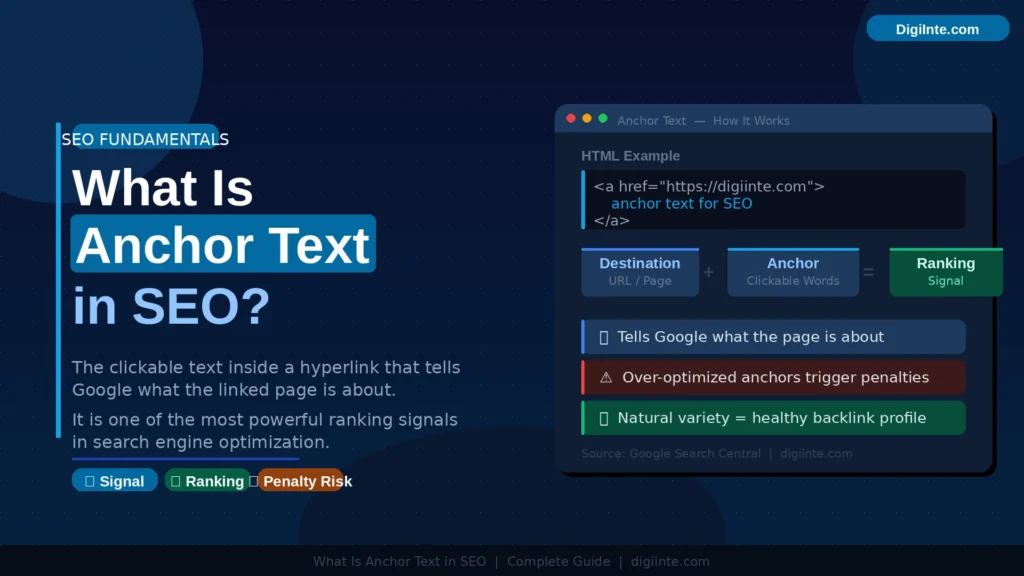
Today Google does not just read the anchor text itself. It reads the surrounding paragraph, the context of the linking page, the overall topic of the linking site, and the historical pattern of anchors pointing to your domain. A single anchor text is one data point. Your entire anchor text profile across hundreds or thousands of links is the picture Google actually evaluates.
If you are new to this topic, our guide on anchor text checker: what it is and how to use it is a good starting point before diving into the full audit process below.
Key insight: In 2026, context carries as much weight as the anchor text itself. A link using the anchor “backlink tools” from a page about SEO software sends a very different signal from the same anchor on a cooking blog. Relevance of the linking page is now inseparable from the value of the anchor.
The 7 Types of Anchor Text Every SEO Needs to Know
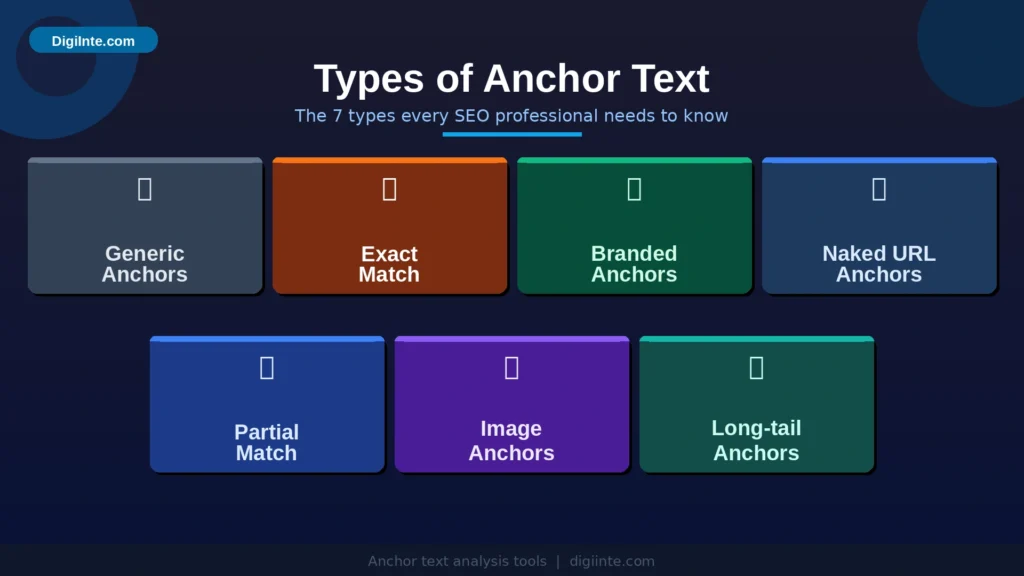
Understanding the different types of anchor text is the foundation of any anchor text audit. Each type sends a different signal and carries different risks and benefits. Here is a breakdown of all seven.
1. Exact Match Anchor Text
This is when the anchor text exactly matches the keyword you want to rank for. For example, if your target keyword is “anchor text for seo” and a linking site uses those exact words as the clickable text, that is an exact match anchor.
Exact match anchors are powerful but risky. Industry data consistently shows that keeping exact match anchors below 5 percent of your total backlink profile is the safe ceiling. Above that level, Penguin filters become increasingly likely to suppress your rankings. Use these sparingly and only when they appear in genuinely editorial contexts.
2. Partial Match Anchor Text
Partial match anchors include your target keyword alongside other words. “Best tools for anchor text SEO analysis” or “how to check anchor text distribution” are partial match examples if your target is “anchor text for seo.” These are safer than exact match and still pass meaningful keyword relevance signals. Most SEO professionals build their link profiles primarily around partial match anchors.
3. Branded Anchor Text
Branded anchors use your company or website name as the clickable text. “DigiInte,” “Ahrefs,” or “Backlinko” are branded anchor examples. A healthy backlink profile has branded anchors making up the largest share, typically 40 to 50 percent of the total. Branded links look natural, carry no penalty risk, and build brand recognition alongside rankings.
4. Naked URL Anchor Text
A naked URL anchor is simply the web address itself used as the clickable text. Links using “https://digiinte.com” or “www.digiinte.com/blog” as the visible text are naked URL anchors. These contribute around 10 to 20 percent of a natural backlink profile and are common in resource pages, citations, and press mentions.
5. Generic Anchor Text
Generic anchors include phrases like “click here,” “learn more,” “visit this page,” and “read the full article.” They pass no keyword relevance signal to the destination page. While they carry no penalty risk, a profile dominated by generic anchors means you are leaving significant ranking potential unrealized. Keep these below 15 percent of your total profile.
6. LSI and Topically Related Anchor Text
LSI anchors are phrases that are semantically related to your keyword without using it directly. If your target is “anchor text analysis,” an LSI anchor might be “backlink profile audit” or “link text distribution.” These are highly valuable because they build topical relevance naturally without triggering keyword-specific filters.
7. Image Anchor Text
When an image is used as a hyperlink, the alt attribute of the image functions as the anchor text. Search engines use the image alt text to understand what the linked page is about. This is a frequently overlooked optimization opportunity. Make sure every linked image has a descriptive alt attribute that reflects the topic of the destination page.
Anchor Text Ratio: What Does a Healthy Profile Look Like
Knowing the types is one thing. Knowing the right ratios is where the practical work begins. Here are the distribution targets most SEO professionals use as a starting benchmark in 2026.
| Anchor Text Type | Target Ratio | Penalty Risk | SEO Signal Strength |
| Branded (company name, domain) | 40 to 50 percent | Very low | Brand authority and recognition |
| Naked URL (www.yoursite.com) | 10 to 20 percent | Very low | Natural citation signal |
| Generic (click here, learn more) | 10 to 15 percent | None | No keyword relevance signal |
| Partial match (related keyword phrases) | 15 to 25 percent | Low when varied | Strong keyword relevance |
| LSI and topically related phrases | 10 to 15 percent | Very low | Topical authority building |
| Exact match (target keyword exactly) | 2 to 5 percent | High above 5 percent | Direct keyword ranking signal |
| Image alt text as anchor | 5 to 10 percent | Very low | Often underutilized opportunity |
Important: These ratios are a starting benchmark, not a universal law. The safest approach is to analyze the anchor text distribution of the top 3 pages currently ranking for your target keyword and match their pattern. If those pages show 45 percent branded and 8 percent exact match, that is the target for your niche.
How to Analyze Anchor Text for SEO: Step-by-Step Process
Running a proper anchor text audit does not need to be complicated. Follow these steps and you will have a clear picture of your current profile and exactly what to do next.
Step 1: Export Your Full Backlink Data
Start by pulling your complete backlink list from one of the major tools. Ahrefs, Semrush, or Moz Pro all provide full backlink exports with the anchor text column included. In Ahrefs, go to Site Explorer, enter your domain, click Backlinks in the left menu, and export the full list as a CSV. In Semrush, go to Backlink Analytics, enter your domain, click the Anchors tab, and export.
Export at least your top 500 backlinks sorted by domain authority. For a thorough audit, export everything and work with the full dataset.
Step 2: Categorize Every Anchor
Open your exported CSV in Excel or Google Sheets. Create a new column called Anchor Type. Go through each row and classify the anchor text into one of the seven types above: branded, exact match, partial match, naked URL, generic, LSI, or image. This step takes time but it is where the real insight comes from.
For large profiles with thousands of backlinks, use Excel’s filter and sort functions to group similar anchors together. Most exact match and branded anchors will cluster visually once sorted alphabetically.
Shortcut: In Ahrefs, the Anchors report already groups your backlink anchors and shows how many backlinks use each one. Sort by number of backlinks to immediately spot which anchors dominate your profile without manually reviewing every row.
Step 3: Calculate Your Current Ratios
Once categorized, count the total number of anchors in each category. Divide each category count by the total number of backlinks and multiply by 100 to get the percentage. Build a simple table showing your current distribution versus the target ratios. Any category significantly above the target is a potential problem. Any category far below is an underutilized opportunity.
Step 4: Check Anchor-to-Page Alignment
The next check is whether your anchors are pointing to the right pages. Pull your top 10 link-receiving pages and check whether the anchors pointing to each one are topically relevant to the content on that page. An exact match anchor for “anchor text for seo” pointing to your homepage instead of your dedicated anchor text guide is a wasted signal. Authority diluted across low-priority pages reduces the ranking impact of your backlinks significantly.
Step 5: Identify Toxic and Spammy Anchors
Look for anchors that are completely irrelevant to your niche, contain unrelated keywords, or appear on clearly spammy domains. In Semrush, the Backlink Audit tool assigns a toxicity score to each link. In Ahrefs, the spam score on the referring domain helps identify low-quality sources. Build a disavow list for links that are both toxic in origin and using manipulative anchors, but only disavow conservatively.
Step 6: Compare Against Your Top Competitors
Pull the anchor text distribution for the top 3 pages ranking for your primary target keyword. Use Ahrefs or Semrush to export their backlink anchor data and run the same categorization. This competitor benchmark is more valuable than any generic ratio guide because it shows you what Google has already decided is natural for your specific niche.
For a complete walkthrough of the entire audit process from start to finish, including how to interpret your results and build an action plan, read our anchor text checker: the complete guide which covers every stage in detail.
Best Tools for Analyzing Backlink Anchor Text in 2026
The right tool makes anchor text analysis 10 times faster and significantly more accurate. Here are the best options available right now, from free to professional.
1. DigiInte SEO Backlink Anchor Text Checker: Best Free Tool for Quick Audits
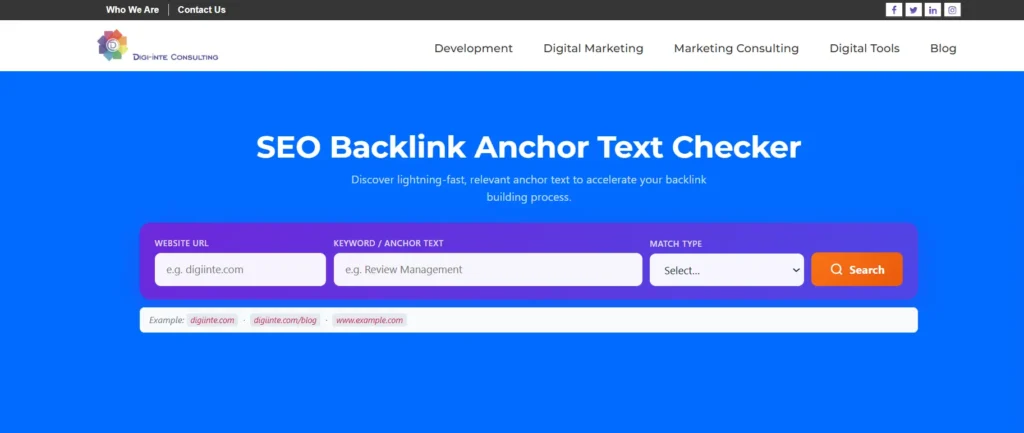
The DigiInte SEO Backlink Anchor Text Checker is a free tool built specifically for fast, no-login anchor text discovery and internal link opportunity analysis. Unlike enterprise tools that require a monthly subscription, this tool is available to anyone at zero cost directly on digiinte.com.
The workflow is simple. You enter your website URL, specify the anchor text phrase you want to find, and choose between phrase match or exact match search mode. The tool scans your site and categorizes anchor texts into branded, exact match, partial match, generic, and naked URL types instantly, giving you a clear overview of your anchor distribution without downloading a single CSV file.
What makes this tool stand out for content teams is the internal linking focus. It pinpoints pages on your site where a specific anchor phrase already exists or could be added, making it easy to build a strategic internal link structure without manually reviewing hundreds of pages. For bloggers and small business owners who want to clean up their internal anchor profile quickly, this is the fastest free option available in 2026.
- Best for:
Bloggers, small business owners, and content teams who need fast free anchor text discovery and internal linking analysis without a paid subscription.
- Pricing:
Completely free. No account or login required.
- Tool URL:
digiinte.com/digital-marketing-tools/seo-backlink-anchor-text-checker/
- Standout feature:
Instant anchor text categorization by type combined with internal link opportunity discovery across your entire site, all for free.
2. Ahrefs: Best Overall Anchor Text Analysis Tool
Ahrefs is the most powerful tool for backlink anchor text analysis. The Site Explorer gives you a dedicated Anchors report that groups every anchor pointing to your domain, shows how many backlinks use each one, the number of referring domains per anchor, and the dofollow versus nofollow split. The backlink index refreshes every 15 to 30 minutes, which means you see new links almost in real time.
The Anchors report lets you filter by anchor type, sort by number of backlinks, and export the full dataset for offline analysis. For competitive anchor research, you can run the same report on any competitor domain without owning it. This is how you benchmark your anchor distribution against the sites currently outranking you.
- Best for:
Professional SEO teams, agencies, and anyone running systematic link building campaigns.
- Pricing:
From $129 per month. Ahrefs Webmaster Tools is free for your own domain.
- Standout feature:
Anchors report with dofollow/nofollow split and competitor anchor comparison.
3. Semrush: Best for Anchor Toxicity Detection
Semrush offers anchor text analysis through both the Backlink Analytics and Backlink Audit tools. The Anchors tab in Backlink Analytics shows your full anchor distribution with percentage breakdowns. The Backlink Audit tool goes further by assigning a toxicity score to each backlink, making it the best choice for identifying which anchors come from genuinely harmful sources.
The Toxic Score feature is particularly valuable for sites that have experienced a ranking drop and need to diagnose whether anchor over-optimization or link toxicity is the cause. Semrush also integrates with Google Search Console, pulling your verified backlink data directly into the audit workflow.
- Best for:
Sites that have experienced ranking drops and need to audit both anchor distribution and link toxicity simultaneously.
- Pricing:
From $165 per month. Limited free searches available.
- Standout feature:
Toxicity scoring combined with anchor analysis in a single workflow.
4. Moz Pro: Best Beginner-Friendly Anchor Analysis Tool
Moz Pro provides clear anchor text reporting through its Link Explorer feature. The interface is cleaner and less data-dense than Ahrefs or Semrush, which makes it the right choice for marketers who are new to anchor text analysis and need straightforward reporting without getting lost in complex filters.
The Spam Score metric helps flag low-quality links at a glance, and the anchor distribution chart gives a visual breakdown of your profile without requiring a manual spreadsheet calculation.
- Best for:
Small businesses, bloggers, and SEO beginners who want clean anchor reporting without a steep learning curve.
- Pricing:
From $99 per month. Free MozBar extension available.
- Standout feature:
Spam Score metric with clean visual anchor distribution reporting.
5. Majestic SEO: Best for Deep Historical Anchor Data
Majestic is a specialist backlink tool with two large indexes: Fresh Index for recent links and Historic Index covering links going back years. The anchor text analysis in Majestic focuses on link quality metrics like Trust Flow and Citation Flow. For sites with long histories or complex backlink profiles built up over many years, Majestic’s historical data provides context that newer tools sometimes miss.
- Best for:
Sites with established link profiles that need historical anchor data and competitor link gap analysis.
- Pricing:
From $49.99 per month. Free limited searches available.
- Standout feature:
Historic index covering years of backlink data with Trust Flow and Citation Flow metrics.
6. Google Search Console: Best Free Anchor Monitoring Tool
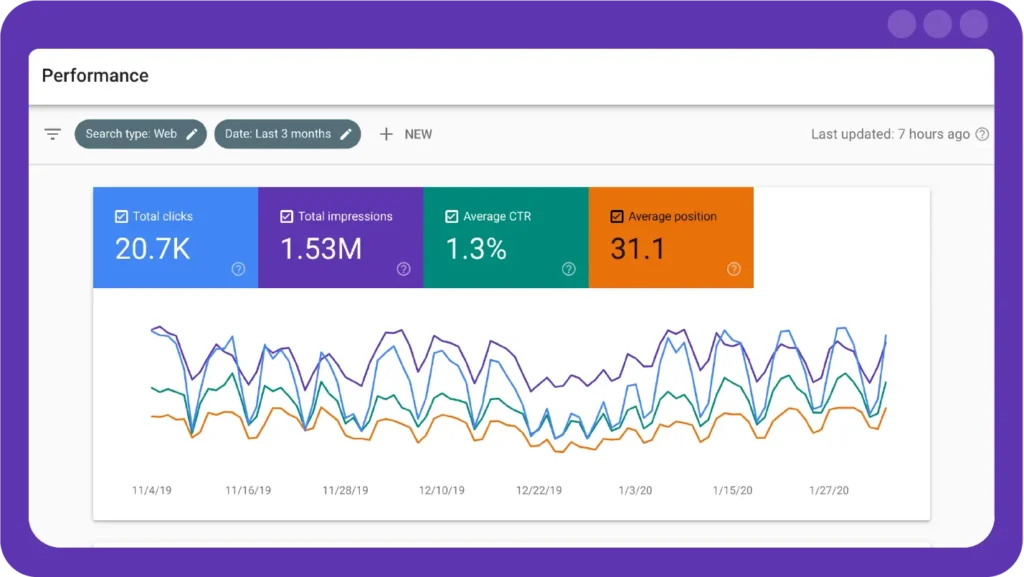
Google Search Console does not provide a dedicated anchor text report, but the Links section shows your top linked pages and the text most commonly used to link to them. Because this is first-party data straight from Google, it is the most accurate picture of which anchors Google has actually registered and is weighing in your rankings.
Use Search Console to cross-check the data from paid tools. If a backlink appears in Ahrefs but not in Search Console, Google may not have crawled or credited that link yet.
- Best for:
Every website at every budget level. This is mandatory and free.
- Pricing:
Free.
- Standout feature:
First-party Google data on which anchors Google actually registers for your domain.
7. SE Ranking: Best Full-Stack Tool at Affordable Price
SE Ranking provides backlink analysis with anchor text reporting at a price point well below Semrush and Ahrefs. The Backlink Checker shows referring domains, anchor text distribution, dofollow versus nofollow splits, and toxicity indicators all in one clean dashboard.
If you want a hands-on walkthrough of how to use an anchor text checker step by step with real examples, our tutorial on how to use a backlink anchor text checker covers the full process from setup to reading your results.
- Best for:
Freelancers, agencies, and mid-sized businesses that need solid anchor analysis without premium pricing.
- Pricing:
From approximately $65 per month.
- Standout feature:
Full anchor text distribution reporting with white-label export for agency clients.
Quick Comparison: Anchor Text Analysis Tools at a Glance
| Tool | Best For | Price | Free Option | Top Anchor Feature |
|---|---|---|---|---|
| DigiInte Anchor Text Checker | Free quick audits and internal links | Free | Fully free forever | Anchor type categorization plus internal link finder |
| Ahrefs | Complete anchor profile analysis | From $129/month | Webmaster Tools | Anchors report with dofollow split |
| Semrush | Toxicity detection and audit | From $165/month | Limited searches | Toxic Score per backlink |
| Moz Pro | Beginners and clean reporting | From $99/month | MozBar extension | Visual anchor distribution chart |
| Majestic | Historical and deep anchor data | From $49.99/month | Limited searches | Historic Index with Trust Flow |
| Google Search Console | Free first-party anchor data | Free | Fully free | Google-verified anchor signals |
| SE Ranking | Affordable full-stack analysis | From $65/month | 14-day trial | White-label anchor reporting |
Common Anchor Text Mistakes That Hurt Your SEO
Mistake 1: Over-Optimizing With Exact Match Anchors
This is the most common and most damaging anchor text mistake. Building too many links with the exact keyword you want to rank for looks manipulative to Google and triggers Penguin filters. The safe ceiling is 2 to 5 percent. Many sites that experienced ranking drops after algorithm updates had exact match anchor ratios of 20 to 50 percent. Recovery requires diluting the profile with branded and generic anchors over several months.
Mistake 2: Using Generic Anchors for All Internal Links
Filling your site with “click here” and “learn more” internal links wastes the topical authority signals you could be passing between your own pages. Replace generic internal anchors with descriptive partial match text that tells both users and search engines what the destination page is about.
Mistake 3: Ignoring Image Alt Text as Anchor Opportunities
Every linked image on your site and in guest posts has an alt attribute that functions as anchor text. Most sites either leave alt text blank on linked images or use generic descriptions. A well-crafted alt attribute on a linked image is a clean, low-risk anchor text signal that most competitors overlook.
Mistake 4: Not Checking Anchor-to-Page Relevance
An exact match anchor pointing to the wrong page is a wasted signal. If partners and guest posts are linking to your homepage with keyword-specific anchors, those relevance signals should be pointing to the specific page that targets that keyword. Audit your top 10 link-receiving pages and confirm the anchors pointing to each one are contextually aligned with the content on that page.
Mistake 5: Running Anchor Analysis Only Once
Anchor text profiles change with every new link you build or earn. Running one analysis and treating it as permanent is how over-optimization problems develop silently. Industry consensus recommends checking monthly for sites actively building links and quarterly for stable sites with no ongoing campaigns.
How to Fix an Over-Optimized Anchor Text Profile
If your analysis reveals that your exact match anchor ratio is above 10 percent, or that a single anchor phrase dominates more than 20 to 30 percent of your total profile, you need a recovery plan. Here is the most effective approach.
Phase 1: Stop Adding Exact Match Anchors Immediately
Halt any link building campaigns that are adding exact match anchors. Do not add a single new link with your target keyword as the anchor until the profile is corrected. Even one more exact match link makes the over-optimization more severe.
Phase 2: Build Offset Links With Natural Anchors
Start acquiring new links using exclusively branded, naked URL, and generic anchors. These offset links dilute the exact match concentration by raising the total count of non-keyword anchors. Target 3 to 5 new natural-anchor links per month during this phase. This approach is safer than disavowing because it adds positive signals rather than just removing negative ones.
Phase 3: Disavow Only As a Last Resort
Disavowing links removes them from Google’s evaluation of your backlink profile. This is appropriate only for links from genuinely spam-level domains with high Spam Scores or from irrelevant networks using clearly manipulative anchors. Do not disavow links simply because they use keyword-rich anchors. The quality and relevance of the linking domain matters more than the anchor text alone.
Recovery timeline: Most sites see measurable improvement in anchor distribution within 2 to 3 months of consistent offset link building. Full recovery from a significant over-optimization issue typically takes 4 to 6 months. Patience and consistency are more effective than aggressive disavowing.
Expert Tips for a Stronger Anchor Text Strategy
- Use competitor benchmarks as your ratio target:
Analyze the anchor distribution of the top 3 pages ranking for your target keyword. Build toward their pattern rather than a generic industry table. What works in your niche is more reliable than any universal benchmark.
- Vary your partial match anchors deliberately:
“Best anchor text analysis guide,” “how to analyze anchor text,” and “anchor text SEO tools compared” are all partial matches for the same topic but each one looks unique in your profile. Never repeat the same partial match phrase when you have a choice.
- Check anchor velocity alongside distribution:
Building 50 links with branded anchors in one week looks as unnatural as building 50 exact match links. Velocity matters as much as distribution. Steady, natural-pace link acquisition with varied anchors is always safer than bursts regardless of anchor type.
- Monitor new and lost links weekly:
Set up email alerts in Ahrefs or SE Ranking for new and lost backlinks. When you gain a new exact match anchor unexpectedly, you know immediately to offset it. When you lose a strong branded link, you know to seek a replacement.
- Optimize anchor text for AI citations too:
AI search engines like ChatGPT and Perplexity cite sources in their answers. The topical signals from your anchor text profile help these platforms understand what your site is authoritative about. A well-diversified anchor profile with strong topical coherence increases the probability that AI engines cite your content when answering relevant questions.
Frequently Asked Questions
Conclusion
Anchor text for SEO is one of the most misunderstood ranking signals available. Used well, it amplifies the relevance and authority of your most important pages. Used carelessly, it triggers filters that suppress your rankings without any obvious warning sign.
The good news is that anchor text analysis is entirely learnable and actionable. You now know the seven types of anchor text, the ideal distribution ratios for a healthy profile, how to run a complete step-by-step audit, which tools give you the most accurate data, and how to recover if your profile is already skewed.
The next step is to actually run the audit. Export your backlink data from Ahrefs or Google Search Console today. Categorize your anchors. Calculate your ratios. Compare them against the top-ranking pages in your niche. The data will tell you exactly what to build next and what to stop doing immediately.
Anchor text analysis is not a one-time task. It is a monthly habit that compounds over time. The sites with the strongest, most natural anchor profiles are the ones that check and adjust consistently, not the ones that optimized once and hoped for the best.

Behind every post at digiinte.com is a team of experienced SEO analysts and digital growth specialists. Our insights are backed by real data, industry research, and hands-on campaign experience — so you get advice that actually moves the needle.