

Last Updated on April 17, 2026 by Digiinte.com Team
Picking the wrong keyword research tool does not just waste your money, it wastes months of content effort. With over 8.5 billion searches processed by Google every single day, the competition for search visibility has never been tighter. Yet the right keyword research tools in 2026 can show you exactly where the gaps are and which terms your competitors have not claimed yet. Whether you run a personal blog, an ecommerce store, or a digital marketing agency, this guide breaks down the 7 best options available today, both free and paid, so you can make a smart choice from the start.
Key Takeaways
- Google Keyword Planner and Google Search Console are the best completely free keyword research tools in 2026.
- Ahrefs and Semrush lead the paid category with the largest keyword databases and the most powerful intent analysis features.
- KWFinder by Mangools is the top pick for finding low competition keywords on a tight budget.
- Ubersuggest and AnswerThePublic are ideal starting points for bloggers doing content ideation.
- The best approach in 2026 is to combine one free tool with one paid tool for maximum coverage.
What Is Keyword Research
Keyword research is the process of finding and analyzing the specific words and phrases that people type into search engines when looking for information, products, or services. It helps content creators and marketers understand what their audience wants and how competitive each search term is, so they can create content that ranks and attracts targeted organic traffic.
Why Keyword Research Still Matters in 2026
Some marketers assumed AI-generated search would make keyword research obsolete. That has not happened. In fact, the rise of AI Overviews in Google Search and answer engines like Perplexity has made precise keyword targeting more important than ever. Content that aligns tightly with search intent gets cited inside AI-generated answers. Content that does not gets buried.
According to Semrush’s 2025 State of Content Marketing report, pages that matched strong keyword intent saw 43 percent more organic clicks than pages that relied on generic topics. That gap is only widening as zero-click searches increase. The tools listed below exist to help you find the exact language your audience uses, before your competitors do.
1. Google Keyword Planner (Free)
Google Keyword Planner is the oldest keyword research tool in this list and still one of the most reliable for raw search volume data. It pulls data directly from Google, which means the numbers are as close to ground truth as you can get without a paid third-party tool.
You need a Google Ads account to access it, but you do not need to run ads. Navigate to the Keyword Planner inside the Google Ads dashboard, enter a seed keyword, and it returns monthly search volume ranges, competition levels, and CPC bid estimates. The main limitation is that volume data is shown in wide ranges (like 1K to 10K) rather than exact figures unless you have an active campaign spending money.

Best for: Beginners, PPC advertisers, and anyone who wants first-party Google data at zero cost.
Pros
- 100 percent free with no usage limits
- Data comes directly from Google, the most reliable source available
- Shows CPC estimates useful for both SEO and paid campaigns
- No coding or technical knowledge required to get started
Cons
- Search volume shown as broad ranges instead of exact numbers unless you run active ads
- Requires a Google Ads account to access, which can be confusing for new users
- Not designed for organic SEO, so lacks keyword difficulty scores and SERP analysis
- Limited keyword suggestions compared to paid tools like Ahrefs or Semrush
2. Ahrefs Keywords Explorer (Paid, with Free Tools)
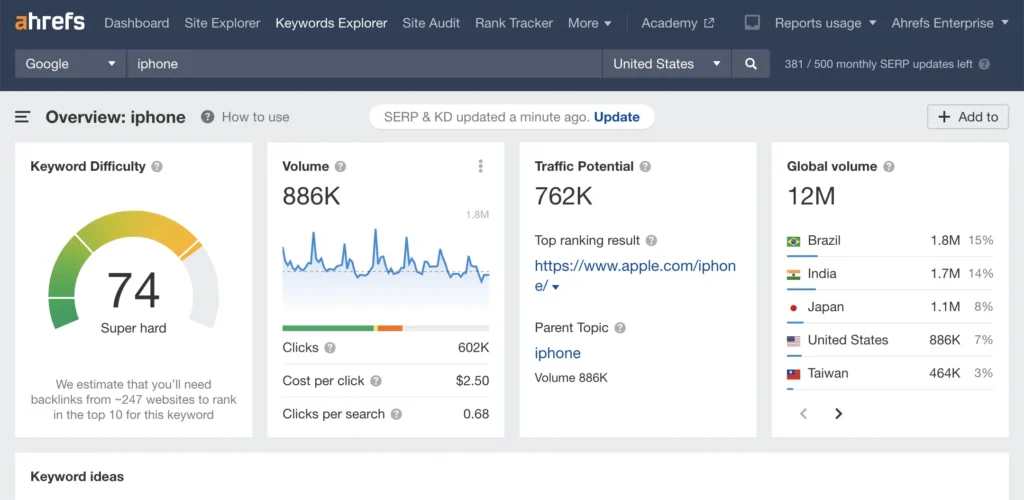
Ahrefs has earned a reputation as one of the most accurate keyword research tools on the market. Its Keywords Explorer pulls data from a database of over 29 billion keywords across 200 countries. What makes Ahrefs stand out is its Keyword Difficulty (KD) score, which is calculated based on the actual number of referring domains pointing to the top-ranking pages, not vague algorithmic estimates.
The Parent Topic feature is particularly powerful. It groups keyword variations under a single parent theme, helping you avoid creating redundant content for near-identical queries. The Traffic Potential metric shows estimated monthly clicks rather than just raw search volume, which matters a lot in 2026 given how many searches now result in zero clicks due to featured snippets and AI answers.
Paid plans start at $129 per month. For freelancers or solo bloggers, the Ahrefs Webmaster Tools free plan gives access to limited keyword data for your own verified domains.
Best for: Professional SEOs, content strategists, and agencies managing multiple client sites.
Pros
- One of the most accurate keyword difficulty scores in the industry
- Traffic Potential metric gives a more realistic forecast than raw search volume
- Massive database of over 29 billion keywords across 200 countries
- Parent Topic feature prevents content cannibalization and duplicate targeting
- Free Ahrefs Webmaster Tools available for your own verified domains
Cons
- Starting price of $129 per month makes it expensive for solo bloggers
- Learning curve is steeper compared to beginner-friendly tools like Ubersuggest
- No built-in AI content generation or writing assistance features
- Reporting and data export options are more limited on lower-tier plans
3. Semrush Keyword Magic Tool (Paid, with Limited Free Tier)
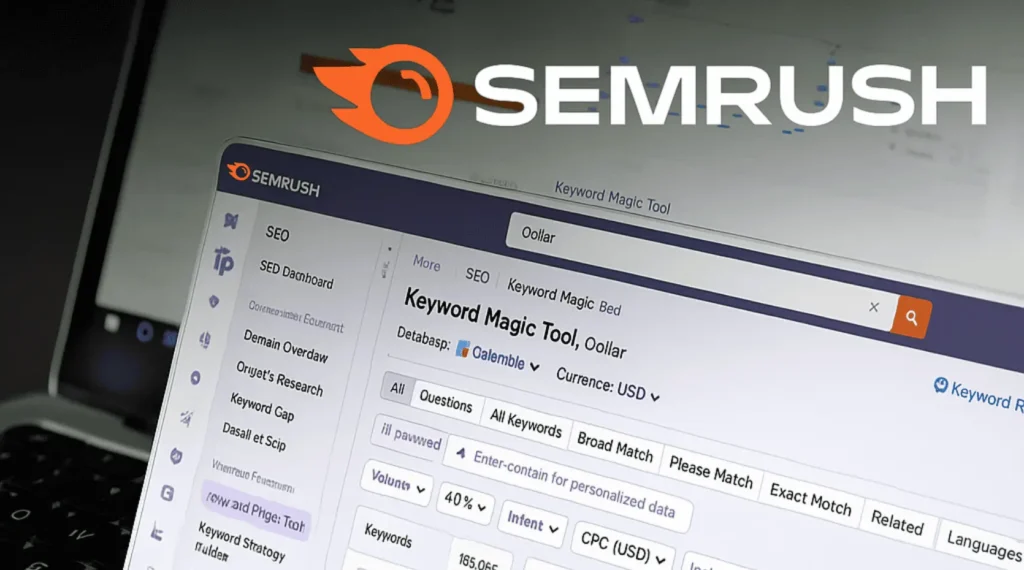
Semrush is the closest thing to a full SEO operating system available in 2026. The Keyword Magic Tool alone can generate millions of keyword suggestions from a single seed keyword, filtered by intent type, question format, search volume, CPC, or difficulty. The database holds over 25 billion keywords globally and is updated daily.
What sets Semrush apart for content teams is its intent classification feature. Every keyword is tagged as Informational, Navigational, Commercial, or Transactional. This maps directly onto the modern Google algorithm, which ranks pages based on whether they match the user’s goal, not just the literal words on the page.
The Keyword Gap tool lets you compare your domain’s keyword rankings against up to four competitors simultaneously, revealing which terms your rivals rank for that you do not. For marketers focused on competitive content strategies, this feature alone justifies the subscription cost.
Paid plans start at $139.95 per month. A limited free account allows 10 keyword lookups per day.
Best for: Marketing teams, agencies, and ecommerce businesses running content-heavy SEO campaigns.
Pros
- Largest keyword database in the world with over 25 billion keywords updated daily
- Intent classification tags every keyword as Informational, Navigational, Commercial, or Transactional
- Keyword Gap tool shows competitor keywords you are missing in seconds
- All-in-one platform covers SEO, PPC, social media, and content marketing
- ContentShake AI generates SEO-optimized article drafts directly from keyword data
Cons
- Most expensive tool on this list at $139.95 per month for the base plan
- The sheer number of features can feel overwhelming for first-time users
- Data accuracy for very niche or regional keywords can be inconsistent
- Free tier is very restrictive with only 10 keyword lookups per day
4. Ubersuggest (Free + Paid)
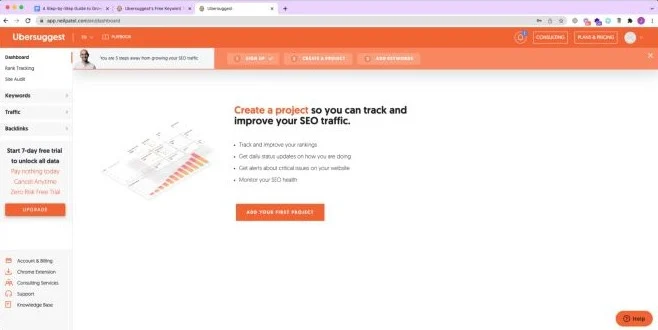
Neil Patel’s Ubersuggest sits in a sweet spot between power and affordability. The free plan allows three keyword searches per day and returns search volume, SEO difficulty, CPC, and up to 150 keyword suggestions per query. For a blogger just getting started, three searches per day covers a full week of content planning if used efficiently.
The paid lifetime deal is one of the best bargains in the keyword research space. A one-time payment gives you full access indefinitely, which stacks up favorably against monthly subscriptions from Ahrefs or Semrush that cost thousands annually. Ubersuggest also includes a content ideas section that shows which articles are already ranking well for a keyword, complete with backlink counts and estimated traffic.
The data quality is not on the same level as Ahrefs or Semrush, but for early-stage sites and personal projects, the difference is rarely meaningful.
Best for: Solo bloggers, startup founders, and content creators on a tight budget.
Pros
- Lifetime deal option means you pay once and own the tool forever
- Free plan is generous enough for bloggers doing light keyword research
- Content Ideas section shows what is already working in your niche
- Clean interface that is easy to navigate without any training
- Includes competitor traffic analysis alongside keyword data
Cons
- Data accuracy lags behind Ahrefs and Semrush, especially for volume estimates
- Free plan limits you to only three searches per day
- Backlink data is less comprehensive than dedicated link analysis tools
- Customer support can be slow to respond on lower-tier plans
5. KWFinder by Mangools (Free + Paid)
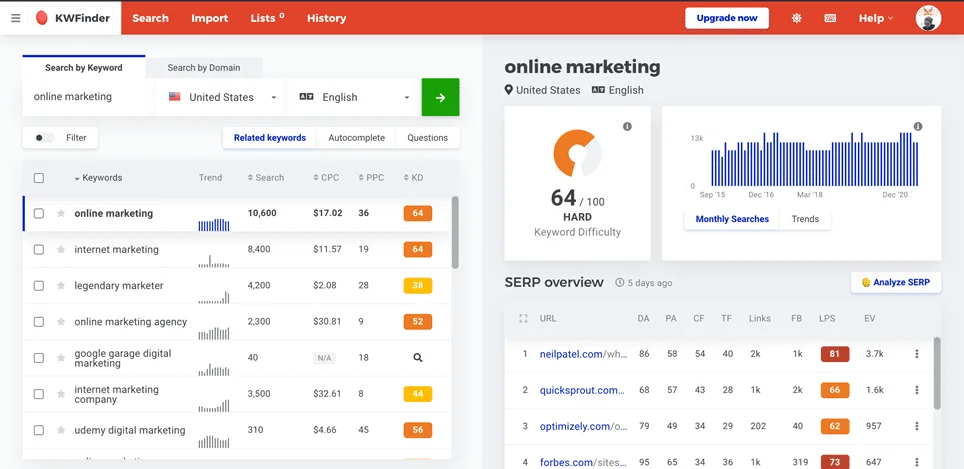
KWFinder is the standout tool for anyone hunting low competition keywords, which remains the most reliable strategy for new websites trying to gain traction. Its difficulty score uses a color-coded scale from green (easy) to red (very hard), making it immediately readable even for users who are new to SEO metrics.
The SERP analysis panel is built directly into the keyword results view. Click any keyword and the right side of the screen shows the actual pages currently ranking for it along with their domain authority, backlink count, and estimated monthly traffic. This removes the need to switch between tools to assess whether a keyword is actually winnable.
KWFinder is part of the Mangools suite, which also includes SERPChecker, SERPWatcher, LinkMiner, and SiteProfiler. All five tools are included under one affordable plan. The free plan allows five searches per day, which is enough to validate keyword ideas before committing to a paid subscription.
Paid plans start at $29.90 per month. This makes it the most cost-effective premium keyword research tool in this list for individuals and small teams.
Best for: New bloggers, niche site builders, and small business owners targeting low competition terms.
Pros
- Color-coded difficulty score is instantly readable with no experience required
- Built-in SERP analysis panel eliminates the need to open a separate tool
- Entire Mangools suite included in one affordable monthly plan
- Best-in-class for identifying low competition long-tail keyword opportunities
- Clean, distraction-free interface makes research fast and enjoyable
Cons
- Keyword database is smaller than Ahrefs or Semrush, which can miss volume on niche terms
- No AI content writing or content brief generation features
- Limited historical data makes it harder to track keyword trend changes over time
- Not ideal for large agencies managing high-volume, multi-client keyword campaigns
6. AnswerThePublic (Free + Paid)
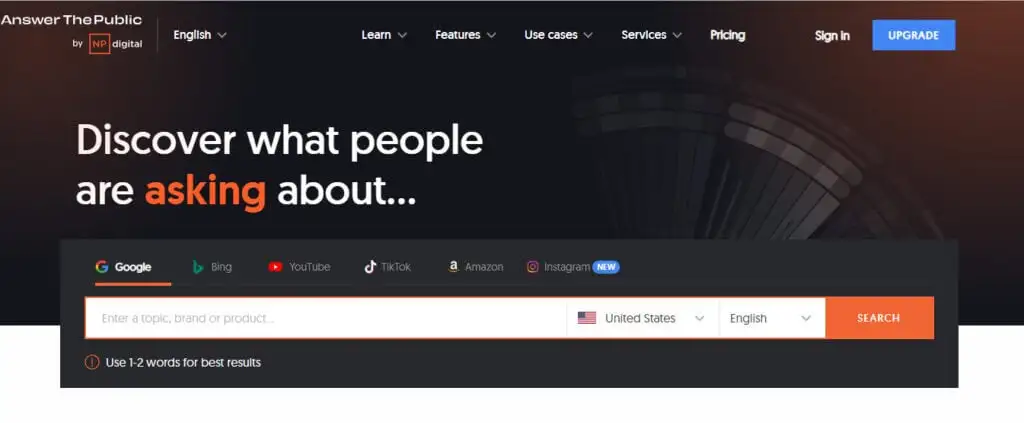
AnswerThePublic works differently from every other tool on this list. Instead of showing you search volume data, it visualizes the questions, prepositions, and comparisons that real people are typing around a seed keyword. Enter a keyword and it returns a wheel of phrases organized into who, what, where, when, why, and how questions.
This makes it exceptional for content ideation rather than competitive keyword analysis. If you want to create blog posts, FAQ sections, or YouTube video scripts that directly answer what your audience is asking, AnswerThePublic delivers ideas you would not find in a standard keyword tool. The 2026 version now pulls data from both Google and Bing searches, broadening the question dataset significantly.
The free plan limits you to a handful of searches per day. The paid plan at $9 per month is remarkably affordable and removes all limits. Neil Patel’s team now owns the tool, and the integration with Ubersuggest is growing with each update.
Best for: Content marketers, bloggers, and video creators looking for question-based content angles.
Pros
- Uniquely visualizes the real questions and comparisons your audience searches for
- Pulls data from both Google and Bing for a broader question dataset
- Paid plan is the most affordable on this list at just $9 per month
- Excellent for building FAQ sections that can rank in AI Overviews and featured snippets
- Requires no SEO experience to get immediate, usable content ideas
Cons
- Does not show keyword search volume, difficulty scores, or CPC data
- Cannot replace a full keyword research tool for competitive analysis or ranking strategy
- Free plan restricts you to a very limited number of searches per day
- Visualization format, while creative, can feel overwhelming with large datasets
7. Google Search Console (Free)
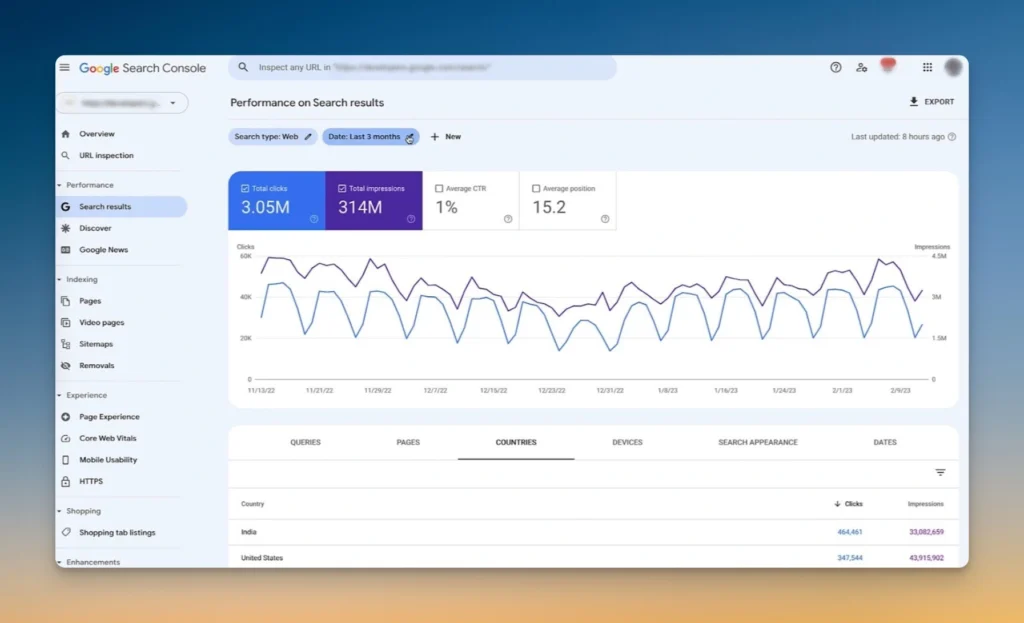
Google Search Console is the most underutilized keyword research tool in this entire list. Most site owners set it up to monitor errors and forget it exists. That is a mistake. The Performance report inside Search Console shows every query that caused your site to appear in Google results, along with impressions, click-through rate, and average ranking position.
This data is pure gold for finding keywords where you are already ranking on page two or three. A page sitting at position 12 for a relevant keyword is one good content update away from page one traffic. No third-party tool can show you this data because it comes directly from your own Google Search index.
Search Console is also free with no usage limits. Connect it to Google Analytics 4 for an even richer picture of which keywords drive conversions, not just clicks.
Best for: Every website owner, at every stage of their SEO journey. There is no reason not to use it.
Pros
- Completely free with no usage restrictions or daily limits whatsoever
- Shows real keyword data from your actual Google Search index, no estimates
- Identifies pages stuck on page two that are easiest to push to page one
- Integrates directly with Google Analytics 4 for conversion tracking by keyword
- The only tool that shows your site’s impressions and click-through rates by query
Cons
- Only shows data for your own website, not for competitor domains
- Does not show keyword difficulty, CPC, or suggestions for new keyword ideas
- Data is limited to the last 16 months, making long-term trend analysis difficult
- Cannot be used as a standalone research tool without pairing it with another option
Quick Comparison: All 7 Tools at a Glance
| Tool Name | Best For | Free Plan | Paid Plan Starts |
| Google Keyword Planner | PPC and beginner SEO | Yes (Google Ads) | Free |
| Ahrefs Keywords Explorer | Advanced SEO research | Limited (free tools) | $129/month |
| Semrush Keyword Magic | All-in-one SEO suite | Limited free tier | $139.95/month |
| Ubersuggest | Bloggers and startups | Yes (3 searches/day) | $29/month |
| KWFinder by Mangools | Low competition keywords | Yes (5 searches/day) | $29.90/month |
| AnswerThePublic | Content ideation | Yes (limited) | $9/month |
| Google Search Console | Tracking real traffic data | Yes (free) | Free |
How to Choose the Right Keyword Research Tool
The honest answer is that no single tool does everything perfectly. Here is how to think about your selection based on your situation.
- If you are just starting out with zero budget: Combine Google Keyword Planner with Google Search Console. You get real Google data for free. Add AnswerThePublic’s free tier for content ideas.
- If you have a small budget of around $30 per month: KWFinder by Mangools is the best value. You get a genuinely capable keyword tool plus four supporting SEO tools under one affordable plan.
- If you are growing a content business or agency: Either Ahrefs or Semrush is worth the investment. Both justify their cost through time saved and competitive insight gained. Ahrefs has a slight edge for link analysis; Semrush has the edge for content gap and intent analysis.
- If content ideation is your primary goal: Pair AnswerThePublic with Google Search Console. The combination of question-based ideas and real ranking data is remarkably effective for blog content planning.
Common Mistakes to Avoid When Doing Keyword Research
- Targeting keywords that are too broad: A new site has no chance ranking for ‘best running shoes.’ Start with specific long-tail variations like ‘best trail running shoes for wide feet under $100.’
- Ignoring search intent: A keyword with 5,000 monthly searches means nothing if your page answers the wrong question. Always verify intent by reviewing what currently ranks before writing.
- Relying on a single tool’s data: No keyword tool is perfectly accurate. Cross-reference volume estimates between at least two tools before building a content strategy around a keyword.
- Skipping competitor analysis: Finding keywords your direct competitors rank for and you do not is often the fastest path to traffic growth. Every major paid tool in this list supports competitor keyword analysis.
- Forgetting to track results: Keyword research is not a one-time task. Use Google Search Console to monitor how your pages rank over time and update content based on real performance data.
Expert Tips for Smarter Keyword Research
- Prioritize Traffic Potential over raw search volume. Ahrefs’ Traffic Potential metric accounts for click-through rate drops caused by featured snippets and People Also Ask boxes, giving a more realistic traffic forecast than volume alone.
- Build topic clusters, not individual keyword pages. Instead of targeting one keyword per article, create a pillar page targeting the broad term and several supporting posts targeting related long-tail variations. Google rewards this structure in 2026.
- Use AnswerThePublic’s question data to write FAQ sections optimized for AI Overviews. Google frequently pulls FAQ content into AI-generated summaries at the top of search results.
- Check keyword seasonality in Google Trends before committing to a topic. A keyword with 8,000 monthly searches in November might drop to 200 in February if it is holiday-driven.
- Review the SERP features column in your keyword tool. Keywords that trigger Shopping results, video carousels, or local packs require different content types than standard blog posts.
FAQ
Conclusion
The best keyword research tools in 2026 range from completely free to several hundred dollars per month, but price does not always equal performance. Google Keyword Planner and Search Console can carry a beginner all the way to meaningful organic traffic when used strategically. KWFinder offers professional-grade data at blogger-friendly pricing. Ahrefs and Semrush are the power tools for teams and agencies with serious SEO ambitions.
Start with what you can afford today, focus on low competition keywords with clear intent, and upgrade your toolset as your site grows. The keyword research process has not changed fundamentally. Only the tools to execute it have gotten smarter.
Pick one tool from this list, set up Google Search Console for free, and start building your keyword list today. The sites ranking on page one a year from now are the ones doing the research right now.
