

Search is undergoing a fundamental shift. Instead of clicking through lists of links, users increasingly receive direct answers from AI systems such as Google AI Overviews, ChatGPT, Perplexity, and voice assistants. This transition is redefining how content is discovered and which websites gain visibility.
For marketers and content teams, relying solely on traditional optimization techniques is no longer enough. To remain visible, brands must understand the evolving relationship between SEO vs GEO vs AEO and how each plays a role in modern search ecosystems.
This guide explains the key differences, strategic implications, and how organizations should adapt their content strategy to remain discoverable in the AI-powered search landscape.
Key Point
- SEO (Search Engine Optimization) focuses on ranking webpages in traditional search engine results pages (SERPs).
- AEO (Answer Engine Optimization) optimizes content to appear as direct answers in featured snippets, voice search, and answer boxes.
- GEO (Generative Engine Optimization) focuses on making content discoverable and citable by generative AI systems such as ChatGPT and Google AI Overviews.
- Future search visibility requires a unified strategy combining SEO, AEO, and GEO, not treating them as separate disciplines.
- Structured content, entity clarity, and topical authority significantly improve the likelihood of being cited by AI systems.
What Is SEO (Search Engine Optimization)?

SEO remains the foundation of online visibility. It focuses on optimizing webpages so they rank highly in traditional search results.
Search engines evaluate hundreds of signals to determine rankings, including relevance, authority, technical performance, and user experience.
Core elements of SEO include:
Keyword Optimization
Identifying search queries users type into Google and creating content aligned with those queries.
Content Quality and Depth
Producing comprehensive resources that demonstrate expertise and satisfy user intent.
Technical SEO
Ensuring search engines can crawl, index, and understand the website efficiently.
Backlinks and Authority Signals
Links from reputable websites signal credibility and domain authority.
User Experience
Fast-loading pages, structured navigation, and mobile-friendly design improve engagement and rankings.
While SEO focuses on ranking webpages, its primary output is still lists of clickable results.
However, the search experience is rapidly evolving toward answer-first interfaces, which introduces new optimization models.
What Is AEO (Answer Engine Optimization)?
AEO focuses on optimizing content so it can be directly extracted and presented as an answer.
Answer engines prioritize concise, structured, and authoritative information that can immediately solve a user’s query.
Examples of answer-driven interfaces include:
- Google Featured Snippets
- People Also Ask results
- Voice assistant responses
- Knowledge panels
To optimize for answer engines, content must be structured in a way that allows search systems to easily extract meaning.
Important AEO tactics include:
Direct Question-and-Answer Formats
Content should clearly address specific questions users ask.
Concise Explanations
Answer engines prefer precise responses that appear within the first few sentences.
Structured Data and Schema Markup
FAQ, How-To, and Q&A schema help search engines interpret content structure.
Clear Heading Hierarchies
Well-organized sections improve content extraction.
AEO does not replace SEO. Instead, it extends SEO by optimizing for answer visibility, not just rankings.
What Is GEO (Generative Engine Optimization)?
Generative Engine Optimization focuses on ensuring content becomes a trusted source for AI-generated responses.
Instead of showing links, generative engines synthesize information from multiple sources to generate answers. Content that demonstrates authority and clarity has a higher probability of being referenced.
Generative search environments include:
- Google AI Overviews
- ChatGPT browsing responses
- Perplexity AI
- Claude and other AI assistants
GEO strategies emphasize:
Topical Authority
Websites with deep content coverage across a topic cluster are more likely to be cited.
Clear Definitions and Structured Knowledge
AI systems prefer content that explains concepts in a structured, logical format.
Credibility Signals
Author expertise, citations, and reputable references increase trustworthiness.
Entity Optimization
Content that clearly defines entities, relationships, and context is easier for AI systems to understand.
The objective of GEO is not just ranking a webpage but becoming a trusted information source that AI systems rely on.
SEO vs GEO vs AEO: Key Differences Explained
Although these strategies overlap, they serve different roles in search visibility.
| Aspect | SEO | AEO | GEO |
| Primary Goal | Rank webpages | Provide direct answers | Become an AI citation source |
| Search Environment | Traditional search engines | Answer boxes and voice assistants | Generative AI platforms |
| Visibility Format | Blue links in SERPs | Featured snippets and voice responses | AI-generated summaries |
| Content Style | Comprehensive and keyword optimized | Concise answers to questions | Structured, authoritative explanations |
| Key Signals | Backlinks, relevance, technical SEO | Clear answers, structured formatting | Authority, entity clarity, topic depth |
Organizations that combine these strategies create content that performs across multiple discovery layers simultaneously.
Why AI Is Reshaping Search Optimization
Traditional search required users to scan through multiple pages to find answers. AI-driven search reduces this friction by synthesizing information instantly.
This shift creates two major implications:
1. Fewer Click-Based Discoveries
AI-generated answers may reduce the number of clicks to websites. Visibility increasingly depends on being referenced in AI summaries.
2. Authority Signals Matter More
AI systems prioritize trustworthy sources. Websites that demonstrate expertise across a topic are more likely to be cited.
Because of this shift, content strategies must prioritize information clarity, credibility, and structured knowledge delivery.
Building a Unified SEO, AEO, and GEO Strategy
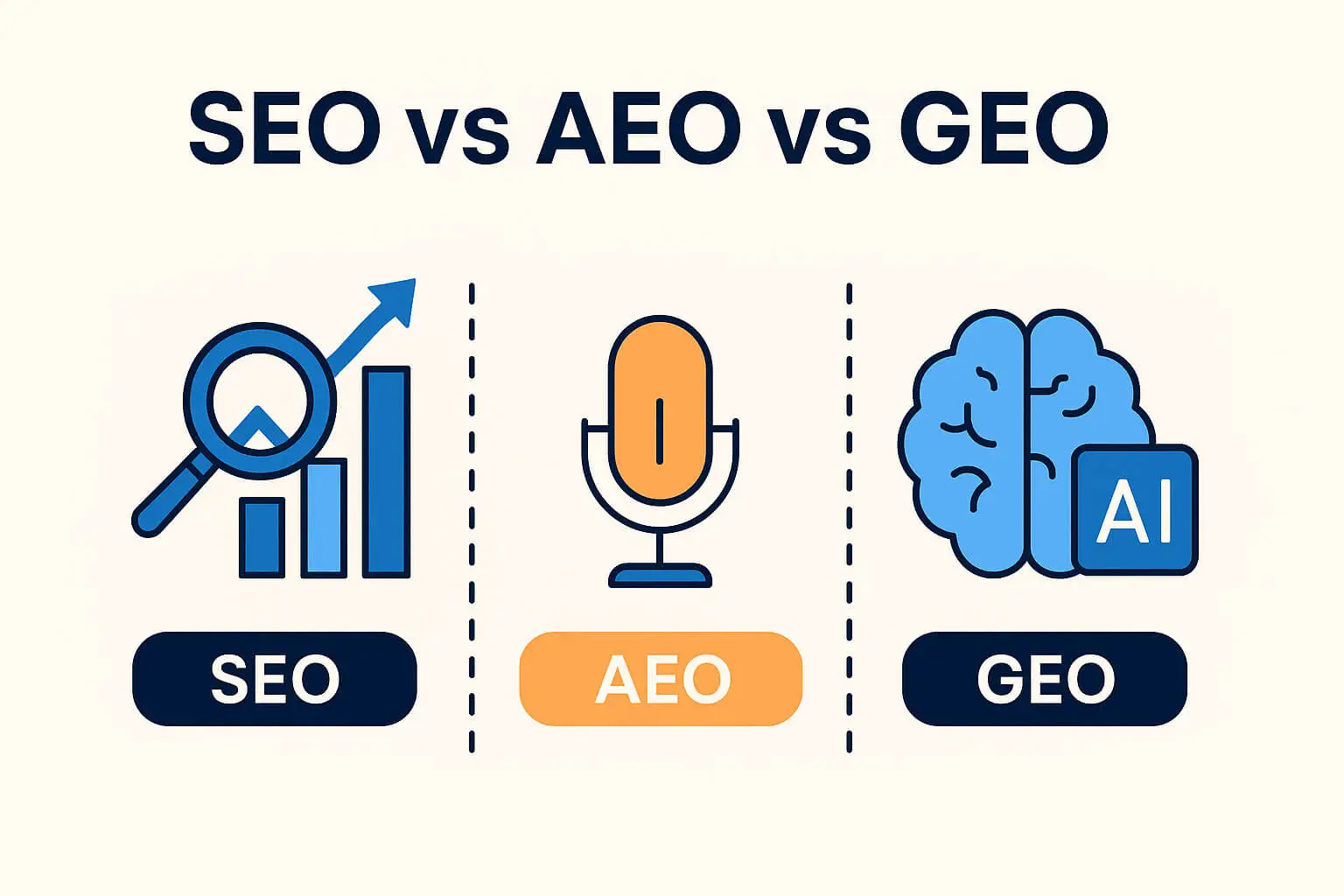
Organizations should not treat these frameworks as competing strategies. Instead, they should create a layered optimization approach.
A practical framework includes the following elements.
1. Create Authoritative Topic Clusters
Develop comprehensive topic coverage instead of isolated articles.
For example:
Main Topic: Learning Management Systems
Supporting Topics:
- LMS implementation
- LMS for healthcare
- LMS pricing models
- LMS features and benefits
Topic clusters signal expertise and improve both search rankings and AI citation probability.
2. Structure Content for AI Extraction
Content should be easy for both search engines and AI systems to interpret.
Best practices include:
- clear headings
- short explanatory paragraphs
- structured definitions
- numbered or bulleted lists
- contextual explanations of concepts
This structure increases the likelihood of appearing in featured snippets and AI-generated summaries.
3. Provide Clear Definitions and Context
AI systems frequently extract introductory definitions from authoritative sources.
Well-written explanatory sections significantly improve citation potential.
For example:
“What is generative engine optimization?” should be answered with a precise explanation within the first paragraph.
4. Build Strong Credibility Signals
Authority signals help AI systems evaluate content reliability.
Examples include:
- expert author bios
- citations to trusted sources
- research-backed insights
- transparent methodology
These signals align with Google’s broader emphasis on Experience, Expertise, Authoritativeness, and Trustworthiness (E-E-A-T).
5. Optimize for Conversational Queries
AI interfaces encourage natural language questions rather than short keyword phrases.
Content should address queries such as:
- What is the difference between SEO and GEO?
- How does generative search work?
- Why is AEO important for voice search?
Addressing conversational queries increases visibility in both AI responses and search results.
The Future of Search Visibility
Search is shifting from link-based discovery to knowledge extraction.
Instead of simply ranking webpages, the goal of modern optimization is to become a trusted information layer within AI systems.
Organizations that invest in:
- structured knowledge content
- authoritative topic coverage
- AI-friendly formatting
will maintain visibility even as search interfaces evolve.
Those relying solely on traditional ranking strategies may experience declining visibility as AI-driven answers dominate search experiences.
Conclusion
Understanding the differences between SEO vs GEO vs AEO is essential for any modern content strategy. SEO continues to drive traditional search rankings, AEO enables visibility in answer-driven interfaces, and GEO ensures content becomes a trusted source within generative AI systems.
Together, these strategies form the foundation of search optimization in the AI era. Businesses that combine structured knowledge, authoritative content, and clear information architecture will be best positioned to remain visible across both traditional search engines and AI-powered discovery platforms.